
The Companies Act amendment now being finalised by Bangladesh’s Ministry of Commerce would make beneficial ownership disclosure mandatory, so that no one can control a company in secret through shares held in another person’s name (benami ownership). It also moves some approvals from the court to the RJSC, expands digital records, raises name-related penalties and updates the rules for One Person Companies.
বাংলায় পড়ুন: কোম্পানি আইন সংশোধন ২০২৬ →- What the Companies Act amendment is about
- What beneficial ownership means
- 6 key proposals of the Companies Act amendment
- Current law vs proposed changes
- Other changes reported in the draft
- Why it matters for foreign investors
- Where the amendment stands now
- What companies should do now
- Common mistakes to avoid
- FAQ
1. What the Companies Act amendment is about
The Companies Act, 1994 is the main law for registering and running companies in Bangladesh. It is administered by the Registrar of Joint Stock Companies and Firms (RJSC). Since 1994 it has had only a few amendments, while business models, technology and global anti-money-laundering standards have changed a lot.
In September 2026 the Ministry of Commerce published a draft Companies (Amendment) Act, 2026 for stakeholder comments. The Federation of Bangladesh Chambers of Commerce and Industry (FBCCI) collected views from trade bodies, and the Commerce Ministry held a stakeholder meeting on 7 September 2026. According to The Business Standard, several changes are based on recommendations from the Bangladesh Financial Intelligence Unit (BFIU).
By late October 2026, reports in Prothom Alo and other newspapers said the draft was close to final. It proposes changes to about 40 sections of the Act. The Companies Act amendment has three main goals:
- Transparency: identify the real owner of every company and stop hidden (benami) control.
- Ease of doing business: let the RJSC handle some approvals that now need a court order.
- Digital administration: allow electronic records, forms, notices and verification.
2. What beneficial ownership means under the Companies Act amendment
A company’s register of members shows who holds its shares. But the person named in the register is not always the person who really owns or controls the company. The real owner or controller is called the beneficial owner.
Example: Mr A wants to keep his identity hidden. He pays for shares that are registered in the name of Mr B. On paper Mr B is the shareholder. In reality Mr A gives the instructions, takes the profits and decides how the company is run. Mr A is the beneficial owner; Mr B is a nominee or benami holder.
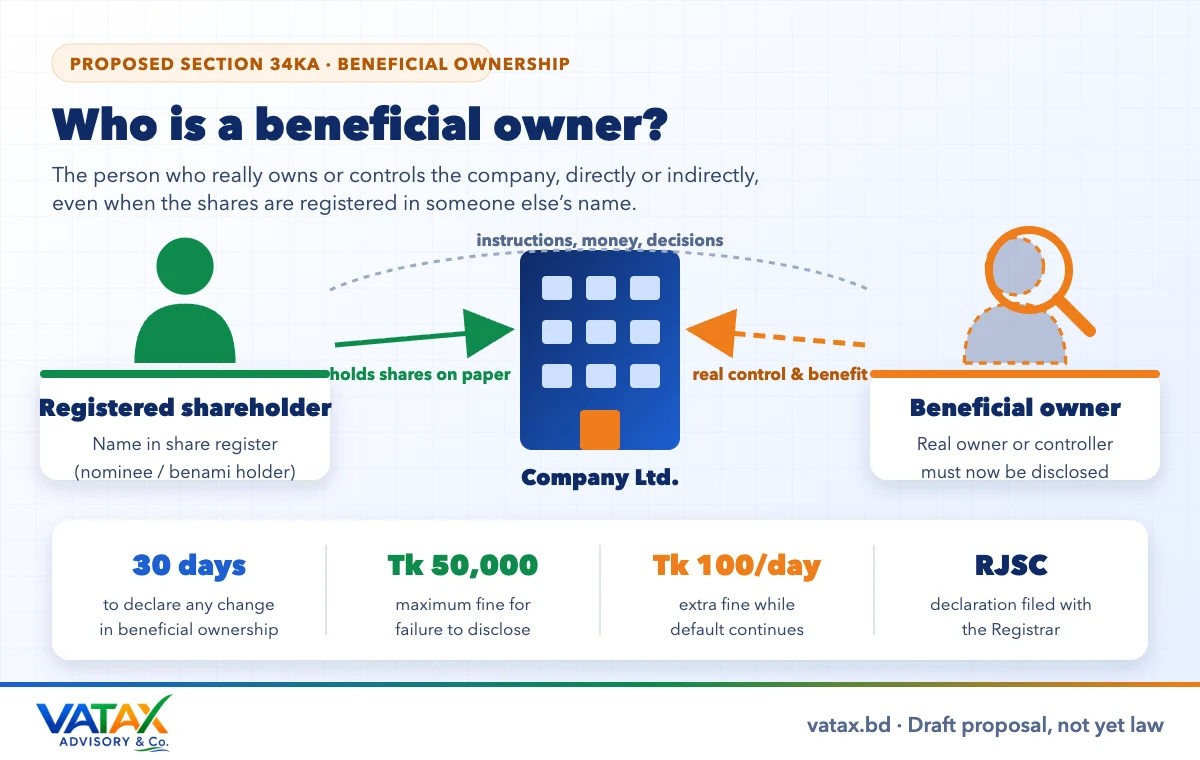
When beneficial ownership is hidden, it becomes hard to trace money laundering, tax evasion, loan default through related companies, and conflicts of interest. That is why international standards, including the FATF Recommendations on transparency of legal persons, expect countries to keep accurate beneficial ownership information.
Under the proposed new section 34Ka, a beneficial owner would include anyone who directly or indirectly owns or controls the company, not only the person whose name appears as shareholder.
3. Six key proposals of the Companies Act amendment
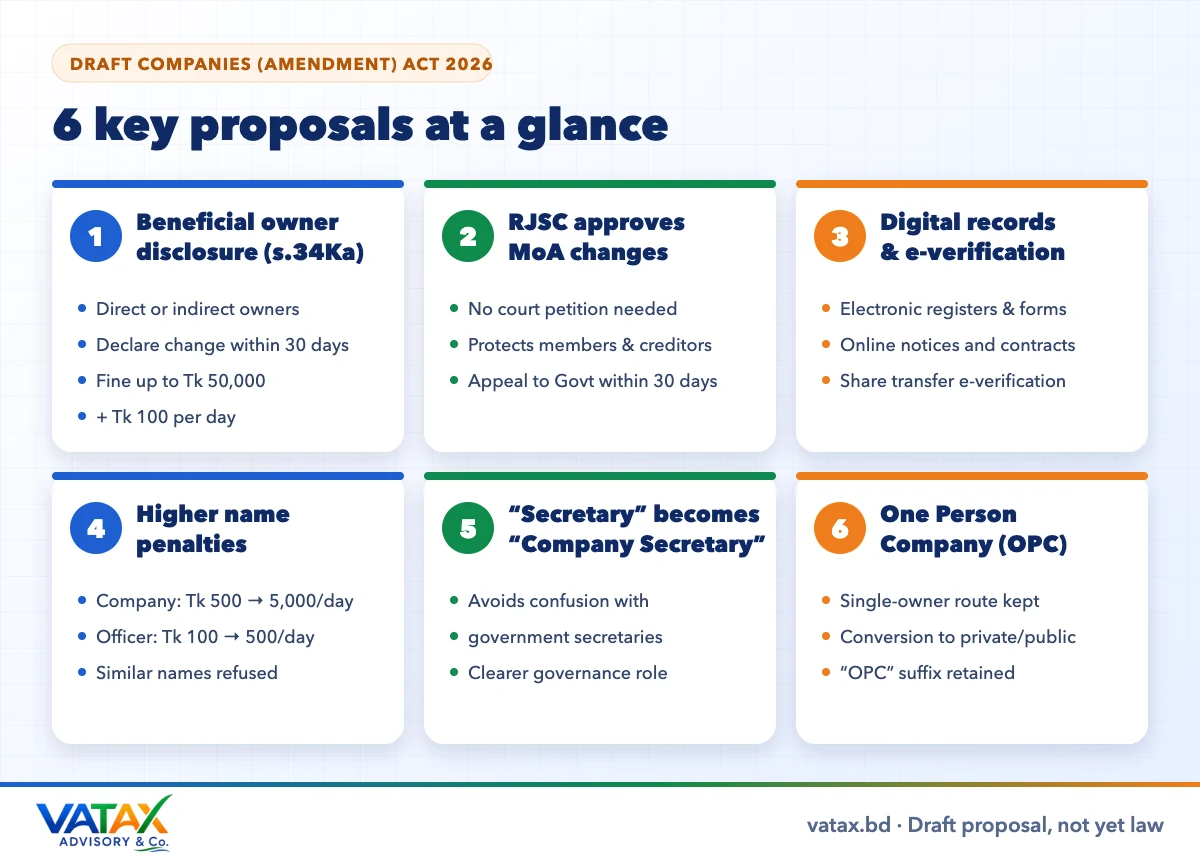
3.1 Mandatory beneficial ownership disclosure (section 34Ka)
This is the centre of the Companies Act amendment. As reported, the draft proposes that:
- the name, identity and other required details of each beneficial owner must be disclosed;
- a new declaration must be made within 30 days of any change in beneficial ownership;
- the information must be filed with the Registrar (RJSC) in a prescribed form;
- failure to disclose may lead to a fine of up to Tk 50,000; and
- if the failure continues, an extra fine of Tk 100 per day may apply.
The September draft reported by The Business Standard also said that a registered shareholder who does not hold the real beneficial interest would have to give the required information within 30 days, that a person who hides beneficial ownership could lose legal rights over the shares, and that companies would have to share ownership and management information with the BFIU, the Anti-Corruption Commission and law enforcement agencies on lawful request.
3.2 RJSC instead of the court for MoA changes
Today, some changes to a company’s Memorandum of Association (MoA), such as changing or widening the objects clause, need confirmation from the High Court Division. This takes time and legal cost.
The Companies Act amendment proposes giving the Registrar of the RJSC the power to approve these changes. The draft keeps safeguards for members, creditors and other affected persons. A person aggrieved by the Registrar’s decision could appeal to the government within 30 days, after paying the prescribed fee.
3.3 Digital records and electronic verification
The draft supports electronic company administration. As reported, it would allow:
- company records to be kept electronically, alongside paper;
- notices, contracts and prescribed forms to be kept and served online;
- share transfers to be verified electronically, not only in person (re-signing or biometric checks were mentioned in the September draft); and
- the existing system of embassy attestation for documents signed abroad to continue.
3.4 Higher penalties for misleading company names
A new company cannot be registered with a name that is misleadingly similar to an existing company. If the government orders a company to change its name and it does not comply, the current daily fine is Tk 500 for the company and Tk 100 for each responsible officer. The Companies Act amendment would raise these to Tk 5,000 per day for the company and Tk 500 per day for the officer. If you need to change a name, see our company name change process in RJSC.
3.5 “Company Secretary” replaces “Secretary”
To avoid confusion with secretaries in government ministries, the draft uses the term “Company Secretary” instead of “Secretary”. The September draft also proposed that listed companies and companies with paid-up capital above Tk 50 crore appoint a qualified company secretary.
3.6 One Person Company (OPC) rules
The One Person Company was introduced by the Companies (Second Amendment) Act, 2020. The new Companies Act amendment keeps and refines this structure for single owners and small businesses. It provides for an OPC to convert into a private or public limited company when set conditions are met, and keeps the name endings “Limited”, “PLC” and “OPC” for each company type. According to The Business Standard, the September draft proposed cutting the minimum OPC paid-up capital from Tk 25 lakh to Tk 5 lakh and raising the maximum from Tk 5 crore to Tk 50 crore.
4. Current law vs the proposed Companies Act amendment
| Topic | Current position | Proposed change |
|---|---|---|
| Beneficial ownership | No general duty to disclose the real owner | New section 34Ka; declaration within 30 days of change |
| Penalty for non-disclosure | None specific | Up to Tk 50,000 + Tk 100 per day |
| Changing MoA objects | Court confirmation in some cases | RJSC Registrar approves; appeal to government in 30 days |
| Records and forms | Mainly paper-based | Electronic records, notices, forms and verification |
| Name-change order ignored | Tk 500/day (company), Tk 100/day (officer) | Tk 5,000/day (company), Tk 500/day (officer) |
| Title of the officer | “Secretary” | “Company Secretary” |
| One Person Company | Allowed since 2020 with capital and turnover limits | Updated limits and conversion route (as reported) |
5. Other changes reported in the September draft
The Business Standard’s report on the September 2026 draft listed further proposals. Some may change after consultation, but they show the direction of the Companies Act amendment:
Registration data
- NID or passport, email, mobile and TIN of directors and shareholders at registration
- Secure digital platform for beneficial ownership data
Governance
- CSR committee of at least three directors, including one independent director
- Directors get 120 days (not 60) to take qualification shares
- Retiring auditors need not be reappointed at the AGM
Clean-up of the register
- Companies inactive or not filing returns for two years can be struck off by a simple procedure
- Directors’ personal liability continues
- Records of dissolved companies kept 5 years (not 3)
Business groups also asked for share buy-backs for listed companies, digital annual reports, AGM timing aligned with the new fiscal year, and a clearer definition of a company group. The Commerce Minister said the government would not rush and would consider stakeholder views.
6. Why the Companies Act amendment matters for foreign investors and large companies
For foreign-owned companies, joint ventures and industrial groups, the Companies Act amendment is more than a local formality.
- Nominee shareholders: a private company needs at least two shareholders. Foreign investors sometimes hold one share through a local nominee or an employee. These arrangements should be properly documented so that the beneficial owner can be declared correctly.
- Group structures: where a Bangladesh company is owned through a holding company abroad (for example in Hong Kong, Singapore or China), you may need to look through each layer to identify the individual who ultimately controls it.
- Banking and KYC: banks already ask for beneficial ownership information under BFIU rules. A matching RJSC record will make account opening, loans and foreign remittances smoother, and mismatches more visible.
- Due diligence: buyers, lenders and partners will be able to rely more on official ownership records, which helps legitimate investors.
Planning a new entity? Read our guides to company incorporation in Bangladesh, FDI company registration and setting up a branch office in Bangladesh.
Worked example: a foreign-owned private company
XYZ Bangladesh Ltd has two registered shareholders. A Hong Kong holding company holds 99 shares, and a local manager holds 1 share as nominee for the same holding company. The Hong Kong company is owned 70% by Ms Chen and 30% by an investment fund with no single controlling investor.
- Register of members: shows the Hong Kong company and the local manager.
- Beneficial ownership: looking through both layers, Ms Chen ultimately owns and controls XYZ Bangladesh Ltd. She is the person to be declared, along with any other individual who controls the company by other means.
- Nominee share: the local manager’s single share should be backed by a written nominee agreement, so the declaration matches the documents.
- If Ms Chen sells her stake: under the draft, a fresh declaration would be due within 30 days of the change.
The final rules and RJSC forms will set the exact thresholds and details to report. Until then, this example shows the kind of information companies should start collecting.
7. Where the Companies Act amendment stands now
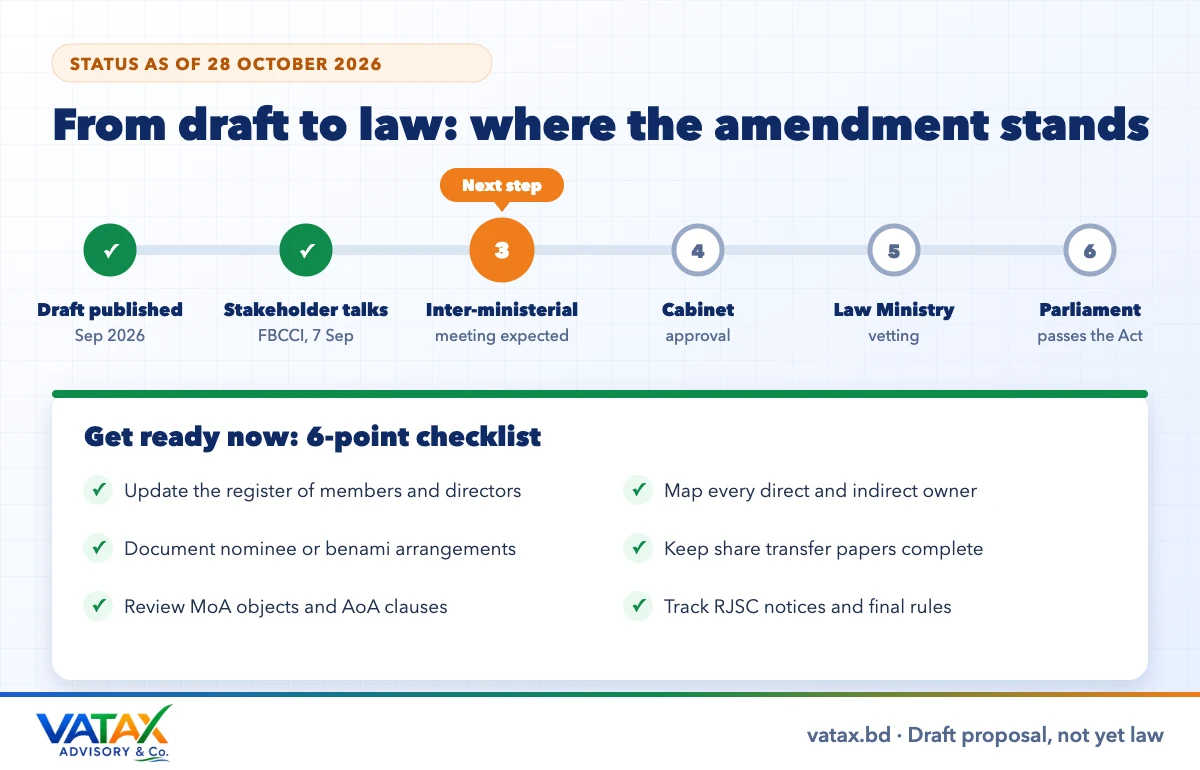
- Draft published (September 2026): the Commerce Ministry released the draft for comments.
- Stakeholder consultation (7 September 2026): meeting at the FBCCI; businesses were given time to send written views.
- Inter-ministerial meeting: according to Prothom Alo (26 October 2026), the Commerce Minister is expected to chair it within about two weeks.
- Cabinet approval of the final draft.
- Law Ministry vetting of the bill.
- Parliament passes the bill; then the RJSC issues rules, forms and guidance.
8. What companies should do now
You do not need to file anything new today. But good records will make the change easy when the Companies Act amendment takes effect:
- Update your statutory registers: members, directors, share allotments and transfers.
- Map your ownership chain: list every direct and indirect owner up to the individuals at the top.
- Document nominee arrangements: keep a signed nominee or declaration of trust agreement for any shares held for someone else.
- Complete share transfer papers: check that every transfer has a proper instrument, stamp duty and RJSC filing.
- Bring RJSC filings up to date: file any overdue RJSC annual return (Schedule X) and other RJSC forms.
- Review your MoA and AoA: note any business you now carry on that is outside the objects clause.
- Align tax and bank records: make sure the owners shown to the NBR, your bank and the RJSC match.
- Follow the final law: the deadlines and penalties above are proposals; check the gazette before acting.
9. Common mistakes to avoid
- Assuming the shareholder in the register is always the beneficial owner.
- Keeping verbal nominee arrangements with no written agreement.
- Ignoring indirect control through a foreign holding company or family members.
- Leaving share transfers unregistered with the RJSC.
- Treating reported draft penalties as final law.
10. FAQ on the Companies Act amendment
Is the Companies Act amendment already in force?
What is a beneficial owner?
How long will companies have to declare a change in beneficial ownership?
What is the proposed penalty for not disclosing?
Will I still need the High Court to change my MoA objects?
Does Bangladesh already allow One Person Companies?
Does this affect foreign-owned companies?
Need help preparing for the Companies Act amendment?
VATax Advisory & Co. reviews your shareholding, nominee arrangements and RJSC filings, and brings your records in line before the new rules arrive. We support foreign companies, Chinese investors, factories and large local groups with company law, VAT and income tax compliance.
Related guides
- Company incorporation in Bangladesh
- RJSC annual return filing
- 25 essential RJSC forms
- Company name change in RJSC
- Branch office in Bangladesh
- Free RJSC & company law MCQ
Sources: Companies Act, 1994 (Laws of Bangladesh); The Business Standard, 4 Sep 2026; The Business Standard, 7 Sep 2026; Prothom Alo, 26 Oct 2026; Bangla Barta, 26 Oct 2026. Disclaimer: this article explains a draft law as reported on the dates above. It is general information, not legal advice. Check the final Act and RJSC rules, or speak to a professional, before acting.


কোম্পানি আইন সংশোধন নিয়ে বেশ ভালো আলোচনা। বিষয়গুলো সহজভাবে তুলে ধরেছেন, যা সবার জন্যই উপকারী। ধন্যবাদ এমন তথ্যবহুল লেখার জন্য।