
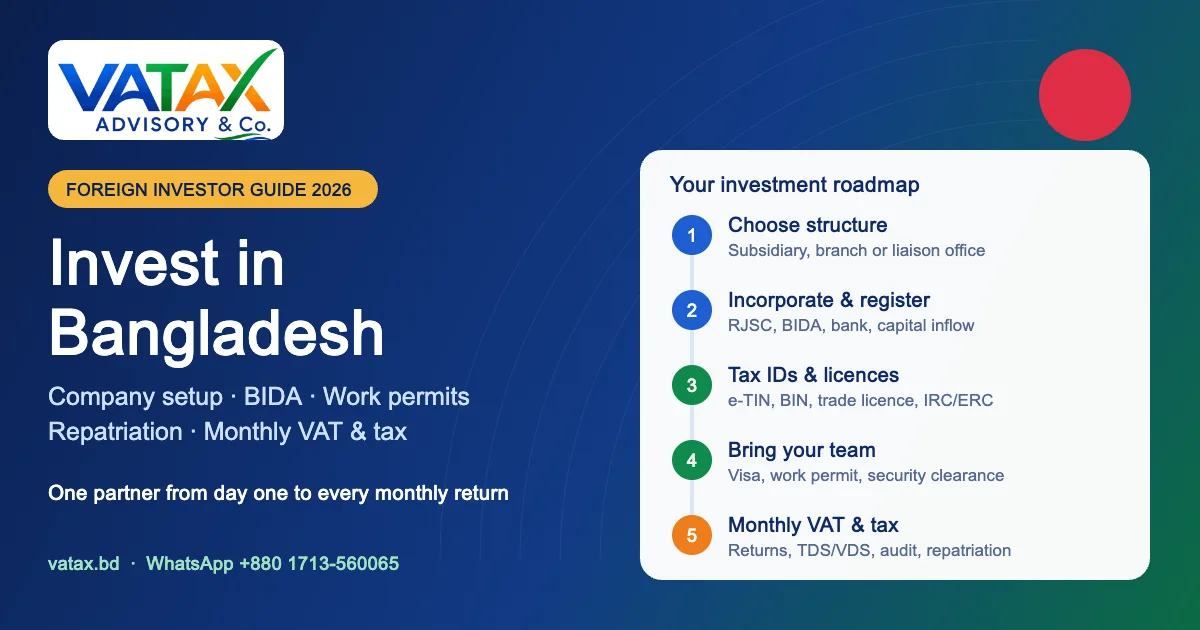
Thinking about how to invest in Bangladesh? This guide walks foreign investors through every step: choosing a structure, incorporating a company or opening a branch, getting BIDA approvals, bringing in foreign staff, paying VAT and tax each month, and sending profits home. It also shows how one local partner, VATax Advisory & Co., can handle the whole journey for you.
1. Why invest in Bangladesh in 2026
Bangladesh is a large and growing market of more than 170 million people, sitting between South Asia and South-East Asia with access to the Bay of Bengal. It is already a global sourcing base for garments and is growing fast in pharmaceuticals, light engineering, electronics assembly, IT services, energy and consumer goods. For many international groups, the question is no longer whether to invest in Bangladesh, but how to do it safely and quickly.
Companies that invest in Bangladesh usually come for three reasons: a young and trainable workforce, competitive operating costs, and a domestic consumer market that keeps growing every year.
The legal framework for those who invest in Bangladesh is investor-friendly:
- 100% foreign ownership is allowed in most sectors, with no requirement for a local partner (a few regulated sectors have limits or need extra licences).
- Legal protection under the Foreign Private Investment (Promotion and Protection) Act, 1980, which protects foreign investment and allows repatriation of capital and returns.
- One Stop Service (OSS): the Bangladesh Investment Development Authority (BIDA) handles registration, office permission, visa recommendations, work permits and remittance approvals online.
- Special zones: export processing zones, economic zones and hi-tech parks offer their own incentives and faster services.
- Tax treaties with many countries can reduce withholding tax on dividends, interest and royalties.
2. How to invest in Bangladesh: choose the right structure
Your structure decides what you can legally do, how you fund the business and what you can send home. Most foreign investors choose one of four options:
| Structure | Best for | What it can do | Key limits |
|---|---|---|---|
| Private limited company (subsidiary) | Long-term investors, factories, service and trading businesses | Full commercial activity, own contracts, local sales, manufacturing | Registered with RJSC; full company law, VAT and tax compliance |
| Branch office | Parent companies trading, contracting or servicing locally | Buy and sell for the parent, consultancy, contracts, after-sales service | No direct production; BIDA permission for 3 years, then renewals |
| Liaison / representative office | Testing the market and supporting distributors | Market research, coordination with agents, suppliers and buyers | Cannot earn local income; all costs funded from abroad |
| Project office | Foreign contractors and JVCAs on a specific project | Run staff and finances for that project | Needs recommendation from the project authority; ends with the project |
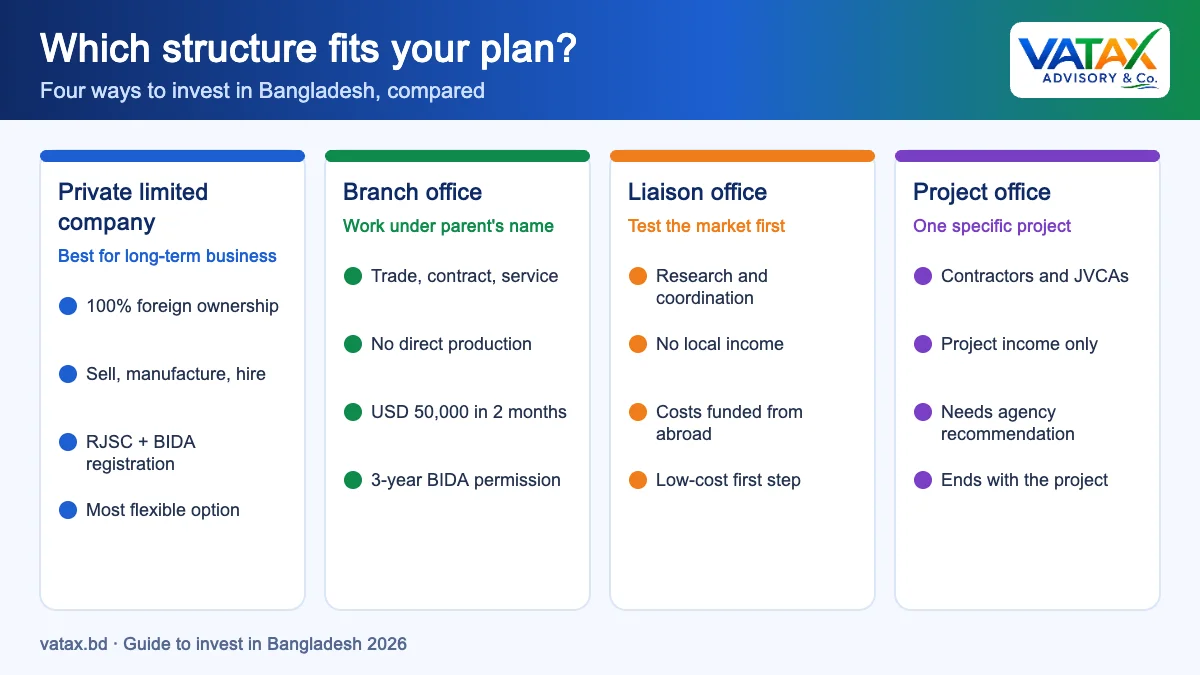
Our view: if you plan to sell, manufacture or hire locally for the long term, a private limited company is usually the best way to invest in Bangladesh. A liaison office is a low-cost first step for groups that want to test the market before they fully invest in Bangladesh. A branch office suits groups that want to work under the parent’s name. Read our detailed branch office in Bangladesh guide for a side-by-side comparison.
3. Company incorporation: 10 steps to invest in Bangladesh
Here is the usual path for a foreign-owned private limited company. Several steps can run in parallel when the documents are ready, which is why a well-prepared file is the fastest way to invest in Bangladesh.
- Name clearance from the Registrar of Joint Stock Companies and Firms (RJSC).
- Prepare the constitution: Memorandum and Articles of Association, shareholder and director details, and board resolutions of the foreign parent (notarised and attested where needed).
- Open a bank account in the name of the proposed company and bring in the share capital from abroad through banking channels. The bank issues an encashment certificate.
- Incorporate with RJSC and receive the certificate of incorporation.
- Register for e-TIN (tax identification number) with the National Board of Revenue (NBR).
- Get a trade licence from the city corporation or local authority for your office address.
- VAT registration (BIN) on the NBR eVAT system.
- BIDA registration through OSS, which you need for visas, work permits and many remittances.
- Import and export registration (IRC/ERC) if you will import machinery or raw materials or export goods.
- Sector licences and the factory or office set-up: environment, fire, factory or industry-specific approvals where they apply.
Use our free RJSC fee calculator to estimate registration costs, and see our full FDI company incorporation service for timelines and the document list.
4. Branch and liaison office rules you must plan for
If you choose to invest in Bangladesh through a branch office, the foreign parent must pass one of three financial tests:
| Route | Requirement |
|---|---|
| 1. Profitable company | Profits for the last three financial years and net assets of at least USD 100,000 |
| 2. Loss-making with reserves | Accumulated profits and net assets of at least USD 1,000,000 |
| 3. Group support | A group company gives a solvency undertaking of at least USD 10,000,000 |
Deadlines after BIDA approval
| Deadline | What you must do |
|---|---|
| Within 30 days | Inform Bangladesh Bank through your Authorised Dealer (AD) bank |
| Within 2 months | Bring in at least USD 50,000 from abroad; each month of delay adds 5% of USD 50,000 |
| Within 7 days of RJSC filing | Inform BIDA after filing the parent’s documents with RJSC |
After that, the office must stay within its approved activities, route all money through a local bank account, file quarterly foreign-currency income and expense statements with Bangladesh Bank, NBR and BIDA, and have IFRS accounts audited by a Bangladeshi chartered accountant firm. Permission is first given for three years and can be extended for up to two years at a time.
For most groups that invest in Bangladesh for the long term, a locally incorporated subsidiary is simpler to run than a branch, because it is not tied to a renewable office permission.
5. Bringing your team: visas, work permits and security clearance
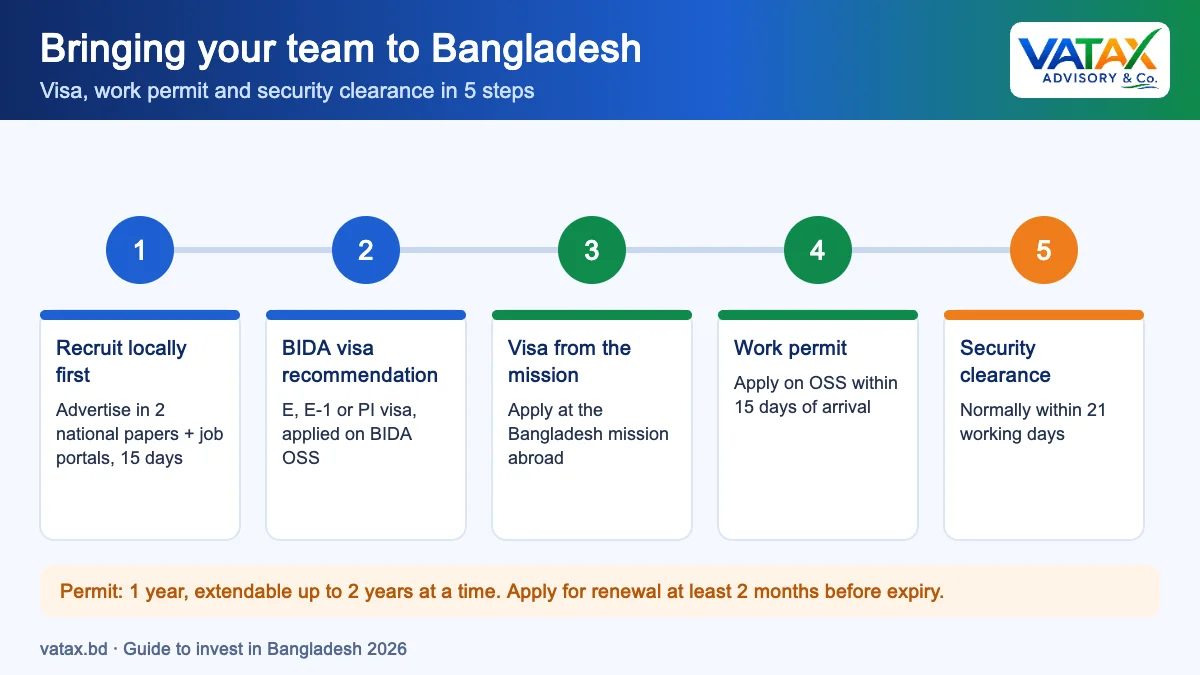
When you invest in Bangladesh, you will usually want some of your own people on the ground. Every foreign national who works here, including an investor who manages the business, needs a BIDA visa recommendation and a work permit.
| Visa | For | Main requirement |
|---|---|---|
| E (Employment) | Foreign employees | Proper local recruitment: advertisement and evaluation report |
| E-1 | Specific contract or service cases | Signed contract and supporting trade or shipment papers |
| PI (Private Investor) | Foreign investors | At least USD 100,000 foreign equity, including USD 40,000 from the applicant’s own funds |
Work permit essentials
- Apply on OSS within 15 days of the worker’s arrival on the right visa.
- Advertise the role in at least two national newspapers and job portals, with 15 days for applications (some senior transfers are exempt).
- Keep the local-to-foreign staff ratio: 10:1 or 20:1 for industry, 5:1 or 10:1 for non-industrial businesses. Investors are not counted.
- Pay salaries in Bangladesh through the bank, within the approved package.
- Permits are normally for one year and can be extended for up to two years at a time. Apply at least two months before expiry.
- Submit a five-year plan to transfer knowledge to local staff.
Security clearance is now faster
Security clearance from the Ministry of Home Affairs is now handled fully on BIDA OSS. Clearance is normally issued within 21 working days, and an attestation letter generated on OSS can be used for a visa extension while checks continue.
6. VAT and tax after you invest in Bangladesh
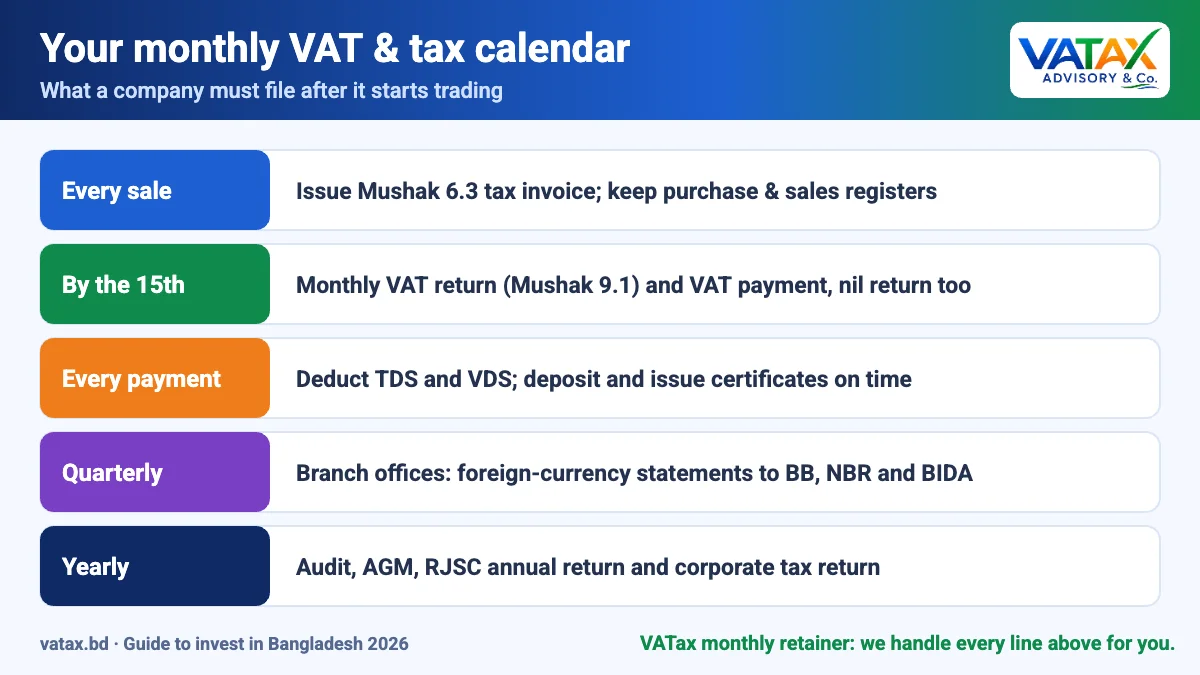
Incorporation is the start. Many companies that invest in Bangladesh underestimate what comes next: most penalties foreign companies face come later, from missed monthly filings. These are the main obligations for every company that chooses to invest in Bangladesh:
| Obligation | How often | Notes |
|---|---|---|
| VAT return (Mushak 9.1) and VAT payment | Monthly, within 15 days of month end | Monthly filing restored from the October 2026 tax period; nil returns are still required |
| Tax invoices and registers | Every sale and purchase | Mushak 6.3 invoices, purchase and sales registers, stock records |
| Tax and VAT deducted at source (TDS/VDS) | Monthly deposit, periodic withholding returns | On salaries, rent, suppliers, services and foreign payments |
| Corporate income tax return | Yearly | Standard rate for most non-listed companies is 27.5%, with lower rates where conditions are met |
| Audit and RJSC annual return | Yearly | Audit by a Bangladeshi chartered accountant firm; AGM and annual return with RJSC |
| Foreign staff tax | Monthly and yearly | Salary TDS and personal returns; the employer is liable if a worker leaves without settling tax |
See our TDS and VDS rate chart 2026-27 and the Mushak 6.3 tax invoice guide for the details your accounts team needs.
7. Repatriating profits, loans and fees
Before they invest in Bangladesh, investors want to know they can bring money home. In Bangladesh you can, if the paperwork is right.
- Dividends from a subsidiary can be remitted after tax, based on audited accounts and board approval, through your AD bank.
- Branch profits: under Bangladesh Bank FE Circular No. 40 (30 September 2026), branch offices can remit profit without prior Bangladesh Bank approval, reporting to Bangladesh Bank within one month after remittance.
- Head-office loans and closing balances can be repaid or remitted, after publishing the required notice to creditors in two newspapers.
- Royalty, technical know-how and assistance fees can be paid once BIDA endorses the agreement, generally up to 6% of the previous year’s sales (excluding VAT), or 6% of the C&F value of imported machinery for projects not yet in operation. Franchise fees above USD 0.1 million are paid 50% / 30% / 20% over three years.
8. Seven costly mistakes to avoid
We see the same problems again and again when foreign groups invest in Bangladesh without local advice:
- Choosing a liaison office when you actually need to earn local income.
- Missing the USD 50,000 inward remittance deadline for a branch office.
- Working outside the activities in your permission letter.
- Filing work permits late, or forgetting to renew two months before expiry.
- Skipping the local recruitment advertisement for foreign roles.
- Paying foreign staff offshore or above the approved package.
- Treating VAT as a quarterly or yearly task: returns are monthly, and late filing brings interest and penalties.
9. Why investors choose VATax Advisory & Co. to invest in Bangladesh
Most foreign investors do not want five different consultants for company law, BIDA, VAT, income tax and accounting. They want one accountable team that speaks their language and knows the rules. That is how we work, and why so many international clients invest in Bangladesh with us as their single point of contact.
Set-up and incorporation
- Structure advice: company, branch or liaison
- RJSC name clearance and incorporation
- Bank account and capital inflow
- e-TIN, BIN, trade licence, IRC/ERC
BIDA and your people
- BIDA registration and office permission
- Visa recommendation (E, E-1, PI)
- Work permits and security clearance
- Renewals before every deadline
Monthly VAT and tax retainer
- Monthly VAT return and VDS
- TDS deposits and withholding returns
- Bookkeeping and corporate tax return
- Audit support and repatriation papers
How we work with overseas clients
- Free video consultation to understand your plan and recommend the right structure.
- A clear document checklist and fixed quote, so you know the cost and timeline before you start.
- We file everything with RJSC, BIDA, NBR and your bank, and keep you updated by email or WhatsApp.
- Monthly compliance on autopilot: after launch, our tax and VAT compliance retainer keeps every return, payment and renewal on time.
10. FAQ: how to invest in Bangladesh
Can a foreigner own 100% of a company in Bangladesh?
What is the best way to invest in Bangladesh?
How long does company incorporation take?
What is the minimum investment for a PI (investor) visa?
How long is a work permit valid?
Can I send profits back to my home country?
How often must a company file VAT returns?
Can VATax handle everything from set-up to monthly compliance?
Ready to invest in Bangladesh?
Planning to invest in Bangladesh this year? Talk to VATax Advisory & Co. today. We will recommend the right structure, give you a fixed quote and handle every step, from company incorporation to your monthly VAT and tax returns.
Related guides
- Company incorporation in Bangladesh
- FDI company registration
- Branch office in Bangladesh
- Companies Act amendment 2026
- BIN and monthly VAT return
- Corporate tax advisory
Sources: Bangladesh Investment Development Authority (BIDA): Guideline for foreign commercial offices, visa recommendation and work permits (2023) and Guidelines for outward remittance of royalty, technical know-how and fees (2021); Bangladesh Bank FE Circular No. 40 (30 Sept 2026); National Board of Revenue; VAT and SD (Amendment) Ordinance, 2026. Disclaimer: this article is general information, not legal advice. Rules change often; where there is any difference, the official guidelines prevail. Speak to us before acting on your specific case.

