
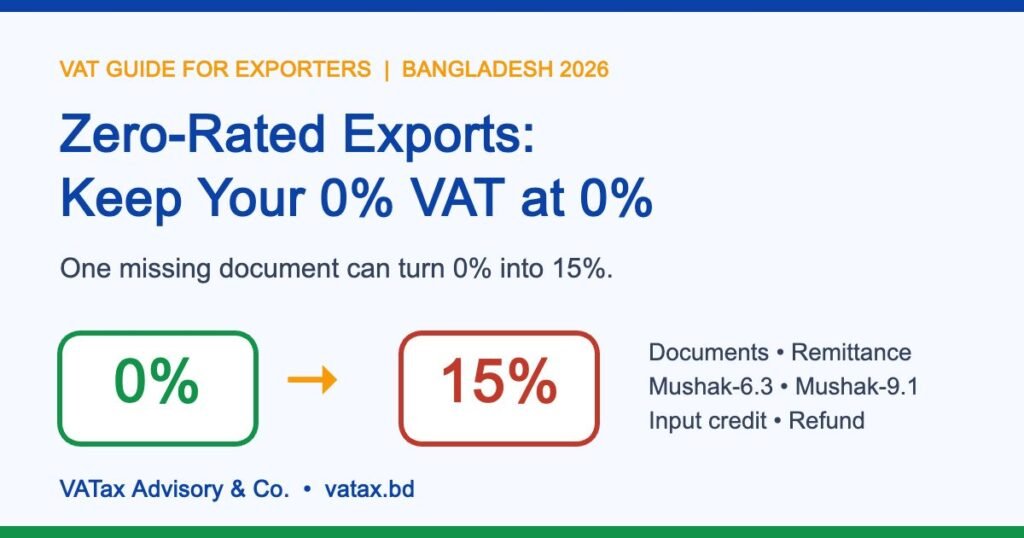
For exporters in Bangladesh, the gap between 0% and 15% VAT is rarely about what you sell abroad. It is about what you can prove. A genuine export with one missing document, or a remittance that does not match its invoice, can be treated by the VAT authority as an ordinary local supply and taxed at the standard 15% rate.
This guide explains how zero-rating works under the Value Added Tax and Supplementary Duty Act 2012, the five areas where exporters most often lose it, and a simple self-check you can run on your own records today.
What does “zero-rated export” mean in Bangladesh?
Exports of goods and services are zero-rated supplies under the VAT and SD Act 2012. That gives exporters two advantages:
- You charge 0% output VAT on the export sale.
- You can claim input tax credit, or a refund, for the VAT you paid on local purchases used to make that export.
Both benefits depend on evidence. If the National Board of Revenue (NBR) is not satisfied that the supply really was an export, the 0% rate falls away and the sale can be assessed at 15%, often with interest and penalties on top.
1. Export documents: the foundation of your 0% rate
Zero-rating is a claim you must be able to defend on paper. Keep a complete file for every shipment or contract, ready to produce when a VAT officer asks.
Export of goods: keep these
- Bill of Export
- Commercial invoice and packing list
- Export LC or sales contract
- Bill of Lading or Airway Bill
Export of services: keep these
- The service agreement and the invoice issued to the foreign client
- Proof of foreign currency payment through a bank: usually an Inward Remittance Certificate or the bank’s repatriation certificate. For service exporters, this is the single most important condition.
- Evidence that the service was used or consumed outside Bangladesh, such as client correspondence, delivery records or the client’s written acceptance
Practical tip: match every export invoice to its remittance. If a USD 10,000 invoice is settled with USD 9,850 because of bank charges, keep the bank advice that explains the difference. Unexplained gaps between invoice and remittance are usually the first thing a VAT officer questions.
2. Input tax credit and VAT refund: the benefit that draws scrutiny
The real value of zero-rating is getting back the VAT you paid on inputs. Because refunds are paid out of government revenue, this is also where checks are strictest.
- Record inputs correctly. The 15% VAT you paid on local raw materials and services must be recorded in the prescribed form and supported by valid supplier tax invoices (Mushak-6.3).
- Apply for the refund properly. With zero output VAT, input credit builds up month after month. To recover it, file the refund application using the prescribed procedure and within the time limit.
- Expect verification. Refunds usually go through an audit or review by the VAT authority before payment. Clean, complete purchase records make that review shorter.
3. Invoices and returns: Mushak-6.3 and Mushak-9.1
- Tax invoice (Mushak-6.3): for a zero-rated supply, the invoice must clearly show a VAT rate of 0%.
- VAT return (Mushak-9.1): report zero-rated sales and exports separately from your other sales, so your input credit can be reconciled correctly against total sales.
Since the VAT and SD (Amendment) Ordinance 2026 brought back filing for each tax period, most businesses now file Mushak-9.1 monthly. For exporters, that means reconciling exports, remittances and input credit every month, not just at year-end.
4. Customs and logistics: your VAT figures must match customs data
- ASYCUDA World: goods exports and bonded facilities run through the customs automated system. The figures in your Bill of Export should agree with what you report in your VAT return.
- Bonded warehouses, EPZs and economic zones: you need to trace the full chain, from raw materials entering to finished goods leaving through customs.
- Misdeclaration: Customs and the VAT Commissionerate monitor together. A mismatch between the two systems is one of the most common triggers for an inquiry.
5. Compliance and misuse: when 0% automatically becomes 15%
- Conditions are strict. For a service export, if the foreign currency does not come in, or the service is actually consumed inside Bangladesh, the supply becomes a 15% taxable supply.
- Disguised local sales are penalised. Showing local sales as exports to claim zero-rating can lead to legal action and penalties for undervaluation or tax evasion.
Exporter self-check: 7 questions to answer today
- Do you have a complete document set for every export shipment or service contract?
- Can every service export invoice be matched to an Inward Remittance Certificate?
- Do your Mushak-6.3 invoices for exports clearly show 0% VAT?
- Are zero-rated sales shown separately in every Mushak-9.1 return?
- Do your Bill of Export figures agree with your VAT return?
- Are your input VAT invoices complete enough to support a refund claim?
- If you use a bond or operate in an EPZ or economic zone, can you trace each input through to the export?
If any answer is “no” or “not sure”, that is exactly where a VAT officer is most likely to look.
Frequently asked questions
Is export VAT 0% or exempt in Bangladesh?
Exports are zero-rated, not exempt. The difference matters: with a zero-rated supply you can still claim input tax credit or a refund on VAT paid for inputs. With an exempt supply, you generally cannot.
What is the most important document for a service exporter?
Proof that payment arrived in foreign currency through a bank, normally an Inward Remittance Certificate or the bank’s repatriation certificate. Without it, the service export can be treated as a 15% taxable supply.
How do exporters get a VAT refund in Bangladesh?
Record input VAT with valid Mushak-6.3 invoices, report zero-rated sales separately in Mushak-9.1, and file a refund application following the prescribed procedure within the time limit. Expect a review or audit before the refund is paid.
How often must exporters file the VAT return?
Following the VAT and SD (Amendment) Ordinance 2026, most businesses, including exporters, file Mushak-9.1 for each monthly tax period.
How VATax Advisory & Co. helps exporters
We support goods and service exporters with BIN registration, monthly VAT return filing, zero-rated invoicing, input credit records and VAT refund applications. Through our monthly VAT, tax and accounting retainer, our team reviews your exports, remittances and returns every month, so your 0% stays 0%.
Book a free compliance review
Phone / WhatsApp: +880 1713-560065
Email: info@vatax.bd
Office: House 154 (1st Floor), Road 1, Baridhara DOHS, Dhaka 1206
This article is general information, not legal advice for a specific case. Rules and procedures can change, so check the current position for your business before you act.

