
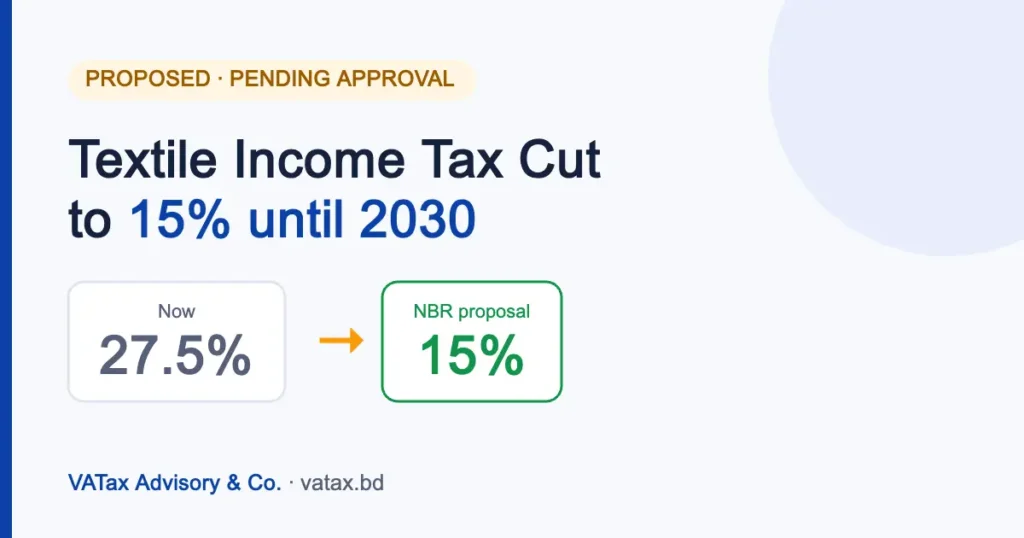
The National Board of Revenue (NBR) has proposed cutting the income tax rate for Bangladesh’s primary textile sector from 27.5% to 15% until 30 June 2030. The NBR has drafted a statutory regulatory order (SRO) and sent it to the Finance Minister for approval. The cut is not yet law: it takes effect only when the SRO is approved and published in the official gazette.
Status at a glance (as of 9 November 2026)
- Current rate: 27.5% (since the earlier 15% concession expired on 30 June 2025)
- Proposed rate: 15%, valid until 30 June 2030
- Legal route: SRO under Section 76(1) of the Income Tax Act, 2023
- Stage: Draft SRO sent to the Finance Minister on 5 November 2026. Approval is still pending.
What has the NBR proposed?
According to The Business Standard, the NBR recommended a 15% income tax rate for textile businesses, kept in place until 30 June 2030. For this purpose, the textile sector covers yarn production, yarn dyeing, finishing, coning, fabric dyeing, printing and related activities. The draft SRO went to Finance Minister Amir Khosru Mahmud Chowdhury. A senior finance official told the paper that the SRO will be issued soon after approval.[1]
Section 76(1) of the Income Tax Act, 2023 lets the government reduce tax rates or grant exemptions for a sector by notification in the official gazette. That is why the change can be made through an SRO in the middle of the fiscal year, without waiting for the next budget.
Why does the textile sector pay 27.5% now?
In 2015, the government set a reduced 15% rate for the textile sector for 10 years through an SRO. That benefit expired on 30 June 2025. As part of a wider plan to cut tax exemptions and raise revenue, it was not renewed.[2] Since then, textile mills have paid the standard 27.5% corporate rate, while export-oriented readymade garment (RMG) makers still pay a reduced rate of up to 12%.[3]
Why does the NBR want to cut the rate?
The NBR’s proposal says the reduced rate is needed to protect exports and jobs and to support sustainable growth in the industry. It points to these pressures:[1]
- Higher gas and electricity prices, and an unreliable energy supply
- High bank interest rates and pressure on working capital
- Lower export incentives, and tougher competition as Bangladesh graduates from LDC status
- Cheaper, subsidised yarn and fabric imported from neighbouring countries
- Most mills running at only 60–70% of capacity
What did the textile millers ask for?
In May 2026, the Bangladesh Textile Mills Association (BTMA) asked the Finance Minister to cut the rate from 27.5% to 10% until 2030. BTMA called the current structure “discriminatory”, since garment exporters pay a much lower rate, and said more than 200 mills have closed.[3] The NBR did not take up the request in the FY2026-27 budget. The new 15% proposal is a middle ground between the industry’s demand and the current rate.[1]
Current vs proposed rates
| Item | Rate / detail |
|---|---|
| Textile sector, 2015 to 30 June 2025 | 15% (SRO, 10 years) |
| Textile sector, current (from 1 July 2025) | 27.5% |
| BTMA demand (May 2026) | 10% until 2030 |
| NBR proposal (November 2026) | 15% until 30 June 2030 (pending approval) |
| Export-oriented RMG, for comparison | 12% |
What it could mean for textile companies
If approved, the cut would almost halve the tax on taxable profits. For example, a mill with Tk 10 crore in taxable income would pay about Tk 1.5 crore at 15%, instead of about Tk 2.75 crore at 27.5%. That is a saving of about Tk 1.25 crore a year, before minimum tax and source tax are considered. This figure is for illustration only. Your actual tax will depend on minimum tax rules, tax already deducted at source, and the exact wording of the final SRO.
Open questions until the SRO is published
- Effective date: will the rate apply to the whole income year 2026-27, or only from the date of the gazette?
- Who qualifies: will spinning, weaving, knit-composite and mixed-activity companies be covered, and how will income from non-textile activities be treated?
- Conditions: will companies need to keep separate accounts, file their returns on time, or meet any compliance requirements?
- Minimum tax and source tax: how will the lower rate interact with tax deducted at source on export proceeds and local sales?
What textile companies should do now
- Keep using 27.5% for now. Until the SRO is published, keep calculating advance tax and provisions at the current rate.
- Prepare a scenario at 15%. Update budgets, deferred tax estimates and cash-flow plans so you can switch quickly once the SRO is issued.
- Separate your activities. If you also earn income from non-textile activities, start keeping separate accounts now. A reduced rate usually applies only to qualifying income.
- Watch the gazette. Read the final wording carefully. The final SRO may differ from the draft.
Need help planning your textile company’s tax position?
VATax Advisory & Co. advises textile and RMG companies on corporate tax planning, source tax, VAT and compliance. We will tell you as soon as the SRO is published.
Book a consultation WhatsApp: +880 1713 560065 · Tax lawyer: 01325 681144
Related: Corporate tax return in Bangladesh · Withholding tax (TDS) return · Corporate tax advisory retainer
Frequently asked questions
Has the textile income tax been cut to 15%?
No, not yet. As of 9 November 2026, it is an NBR proposal. The draft SRO is waiting for the Finance Minister’s approval.
How long would the 15% rate last?
Under the proposal, until 30 June 2030.
What rate do textile companies pay now?
27.5%, which has applied since the earlier 15% concession expired on 30 June 2025.
Does this affect garment exporters?
No. Export-oriented RMG companies have their own reduced rate of up to 12%. This proposal covers the primary textile sector, such as yarn, dyeing, finishing and printing.
References
[1] The Business Standard, “NBR moves to cut textile sector income tax to 15% until 2030”, 8 Nov 2026 — tbsnews.net
[2] The Business Standard, “Govt plans to scrap reduced tax benefits for textile sector”, 19 May 2025 — tbsnews.net
[3] The Business Standard, “Textile millers propose reducing income tax from 27.5% to 10%”, 24 May 2026 — tbsnews.net
Disclaimer: This article is based on news reports about a proposal that has not yet been approved, and is for general information only. It is not tax advice. The final rate, start date and conditions will depend on the SRO as published in the official gazette.

