
Partnership firm registration in Bangladesh gives your business legal recognition with the RJSC, protects your right to sue on contracts, and opens the door to a bank account, trade licence, TIN and BIN in the firm's name. This complete, easy guide explains who can form a partnership, what the partnership deed must say, the documents, the RJSC process step by step, the costs, and what to do after registration.
- What is a partnership firm?
- Why register a partnership firm?
- Who can be a partner?
- The partnership deed
- Documents required
- RJSC registration process: 6 steps
- Cost of partnership firm registration
- After registration
- Tax and VAT of a firm
- Partnership deed tips
- Firm vs proprietorship vs company
- Changes, new partners and dissolution
- Common mistakes
- বাংলায় সংক্ষেপে
- FAQ
What is a partnership firm in Bangladesh?
A partnership is the relationship between two or more persons who agree to share the profits of a business carried on by all of them, or by any of them acting for all. The persons are called partners, and together they are called a firm. Partnerships in Bangladesh are governed by the Partnership Act, 1932, and firms are registered with the Registrar of Joint Stock Companies and Firms (RJSC), an office under the Ministry of Commerce.
A partnership firm is simple to form and run. There are no shareholders, no board meetings and no annual return to RJSC like a company. The trade-off is that partners are personally liable for the debts of the firm. That is why a clear partnership deed and proper registration matter so much.
Why register a partnership firm?
Registration of a partnership firm is not compulsory under the Partnership Act, 1932, but an unregistered firm faces serious limits. Under section 69, an unregistered firm, or a partner of it, cannot file a suit against a third party to enforce a right arising from a contract. In practice, registration is the safer choice for any serious business.
- Right to sue: a registered firm can enforce its contracts in court.
- Bank account: banks normally ask for the RJSC registration certificate to open a current account in the firm's name.
- Trade licence, TIN and BIN: the registered deed and certificate support every later registration.
- Credibility: buyers, suppliers, landlords and government offices trust a registered firm.
- Import and export: a firm that wants an IRC or ERC needs clean registration documents.
- Clear record of partners: the RJSC record shows who the partners are, which helps in disputes, retirements and new admissions.
Who can be a partner?
- Number of partners: at least 2. Under the Companies Act, 1994, a partnership for business may not have more than 20 partners (10 for banking business); a larger business must register as a company.
- Adults: any adult of sound mind who can enter into a contract, including Bangladeshi and foreign nationals.
- Minors: a minor cannot be a full partner, but can be admitted to the benefits of the partnership with the consent of all partners, and is not personally liable for the firm's losses.
- Companies and other firms: whether an entity can join depends on its own constitution; take advice before including a company as a partner.
The partnership deed: what it must include
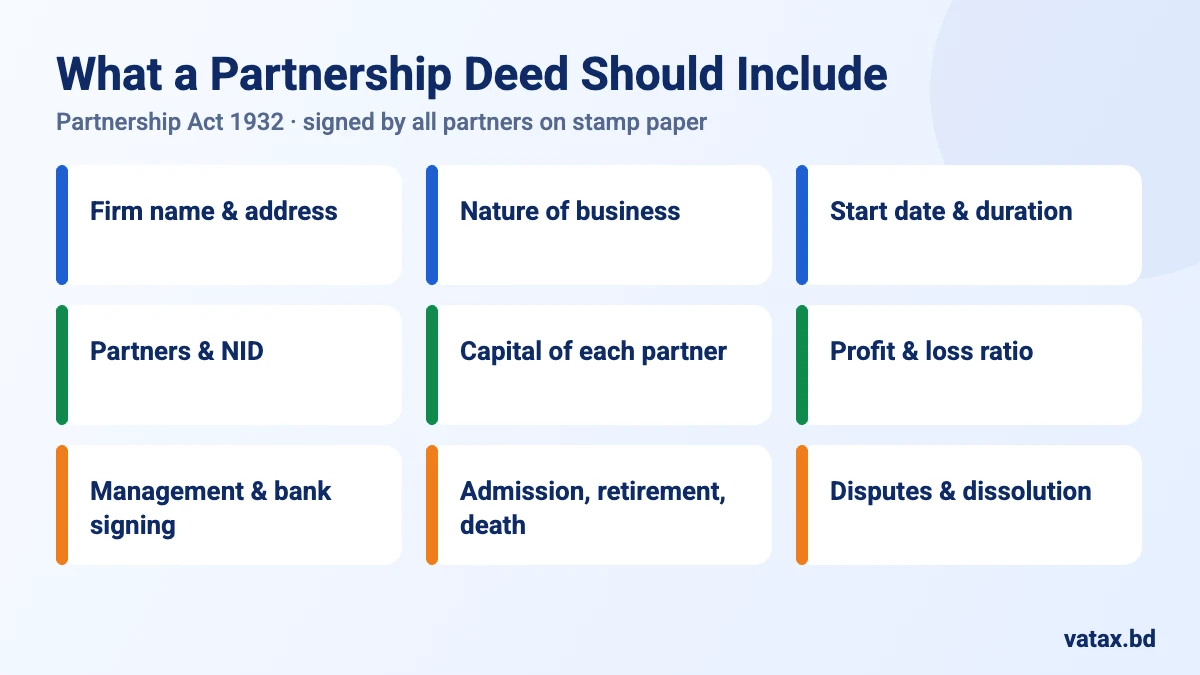
The partnership deed is the written agreement between the partners. It is executed on non-judicial stamp paper under the Stamp Act, 1899 and signed by all partners. A well-drafted deed prevents most partnership disputes.
Firm details
- Name of the firm
- Principal place of business and branches
- Nature of business
- Date of commencement and duration
Partner details
- Names, addresses and NID/passport
- Date each partner joined
- Capital contribution of each partner
- Profit and loss sharing ratio
Management rules
- Who manages and signs for the firm
- Bank account operation
- Salary, interest on capital and drawings
- Admission, retirement and death of a partner; dispute resolution and dissolution
Documents required for partnership firm registration
- Name clearance certificate from RJSC for the proposed firm name
- Partnership deed on non-judicial stamp paper, signed by all partners
- Form I (statement for registration of a firm), signed by all partners
- NID or passport of every partner
- Passport-size photo of every partner
- e-TIN certificate of partners (recommended, and needed for many later steps)
- Address of the principal place of business (and branches, if any)
- Mobile number and email address for the RJSC online account
RJSC partnership firm registration process: 6 steps
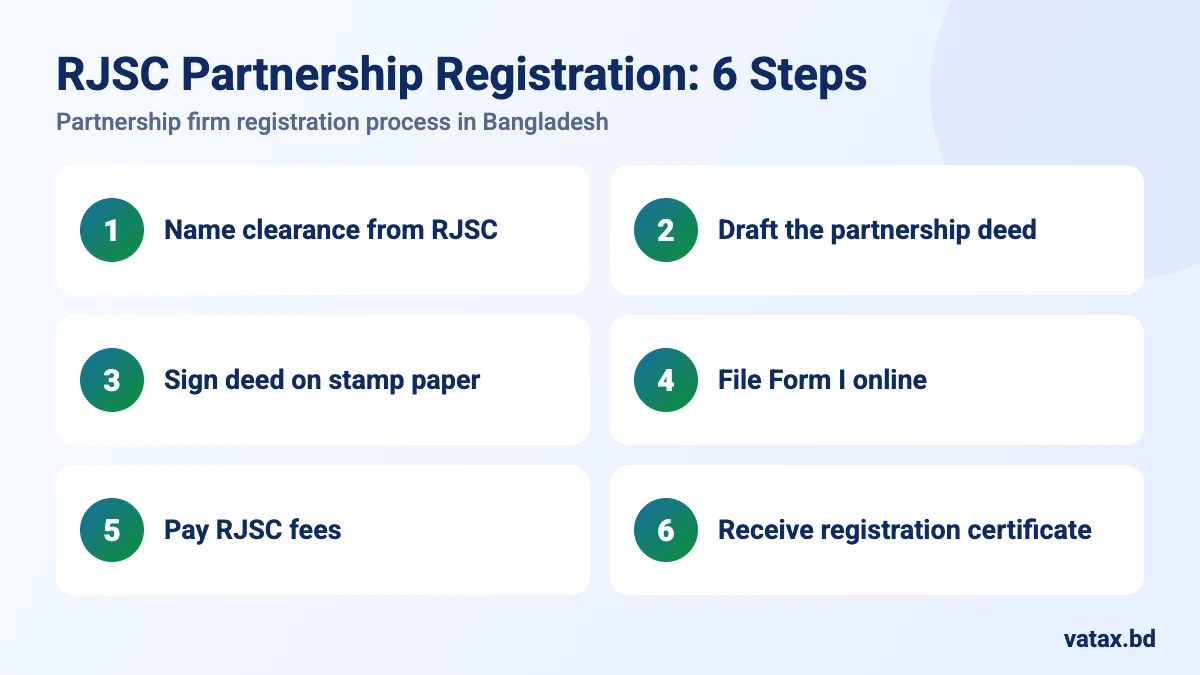
- Name clearance. Apply online on the RJSC system for clearance of the proposed firm name. The name must not be identical or too similar to an existing registered name and must not be misleading or prohibited.
- Draft the partnership deed. Prepare the deed with all the terms above. We draft it to match your business and protect each partner.
- Execute the deed on stamp paper. Print the deed on non-judicial stamp paper of the required value and have all partners sign it. Many firms also have the signatures attested by a notary public.
- File Form I online. Submit the Form I statement with the scanned deed and partner documents through the RJSC online system.
- Pay the RJSC fees. Pay the fees shown by the RJSC system through the approved payment channel and keep the receipt.
- Receive the certificate. After scrutiny, RJSC registers the firm and issues the certificate of registration, which can be downloaded from the online system.
Cost of partnership firm registration in Bangladesh
| Cost item | Amount / basis |
|---|---|
| RJSC name clearance | Tk 500 per proposed name (RJSC fee schedule) |
| Name clearance time extension | Tk 200 per extension |
| RJSC firm registration fee | As shown on the RJSC payment screen at the time of filing |
| Stamp duty on partnership deed | Non-judicial stamp of the value required under the Stamp Act, 1899 (commonly Tk 2,000) |
| Notary attestation (optional) | Notary's charge |
| Professional fee | Agreed with you after we review your requirements |
What to do after registration
- Trade licence: apply to the city corporation, municipality or union parishad for a trade licence in the firm's name.
- e-TIN for the firm: register the firm for income tax and get its own TIN.
- BIN or turnover-tax enlistment: since the Finance Act 2026, a business needs a BIN or enlistment certificate to open or operate a business bank account, take a loan and renew a trade licence. See our BIN mandatory guide and VAT registration guide.
- Bank account: open a current account in the firm's name, operated as the deed provides.
- IRC and ERC: if you import or export, apply for an IRC or ERC.
- Other licences: fire licence, environment clearance or sector permits, depending on your business.
- Ongoing compliance: keep books, file the firm's income tax return every year and file VAT returns monthly if registered. Our monthly bookkeeping service keeps this simple.
Tax and VAT obligations of a partnership firm
A partnership firm is not a separate legal person, but for income tax it is treated as a separate taxpayer. That means:
- the firm needs its own e-TIN and files its own income tax return every year;
- each partner also shows their share of the firm's income in their personal return, as the Income Tax Act, 2023 requires;
- if the firm pays rent, contractor bills or professional fees as a specified person, it must deduct TDS at the correct rate (see our TDS and VDS rate chart 2026-27);
- if its turnover crosses the VAT registration threshold, it needs VAT registration (BIN) and must file a monthly VAT return, which from 1 October 2026 is due within 15 days after each month for most businesses;
- smaller firms can take turnover-tax enlistment instead and file the turnover tax return.
Getting these registrations right at the start avoids penalties, blocked bank accounts and problems at trade licence renewal.
Partnership deed tips from a tax lawyer
- Write down capital and profit ratios separately. Capital contribution and profit share are not always the same; the deed should state both.
- Plan for exit. Include how a partner can retire, how their share is valued and how it is paid out.
- Cover death and incapacity. State whether the firm continues and how the legal heirs are dealt with.
- Set bank signing rules. Say who signs cheques and up to what amount, and when joint signatures are needed.
- Choose a dispute route. An arbitration clause can save years in court.
- Keep it consistent. Use the same firm name and address on every document you file later.
Partnership firm vs sole proprietorship vs private limited company
| Sole proprietorship | Partnership firm | Private limited company | |
|---|---|---|---|
| Owners | 1 | 2 to 20 partners | 2 to 50 shareholders |
| Law | No special registration law | Partnership Act, 1932 | Companies Act, 1994 |
| Registered with | Trade licence only | RJSC (firm) | RJSC (company) |
| Liability | Unlimited | Unlimited, joint and several | Limited to shares |
| Separate legal entity | No | No | Yes |
| Annual RJSC filing | None | Only when details change | Annual return and AGM |
| Best for | Very small, single-owner business | Small and medium businesses run by trusted partners | Growing businesses, investors, foreign shareholders |
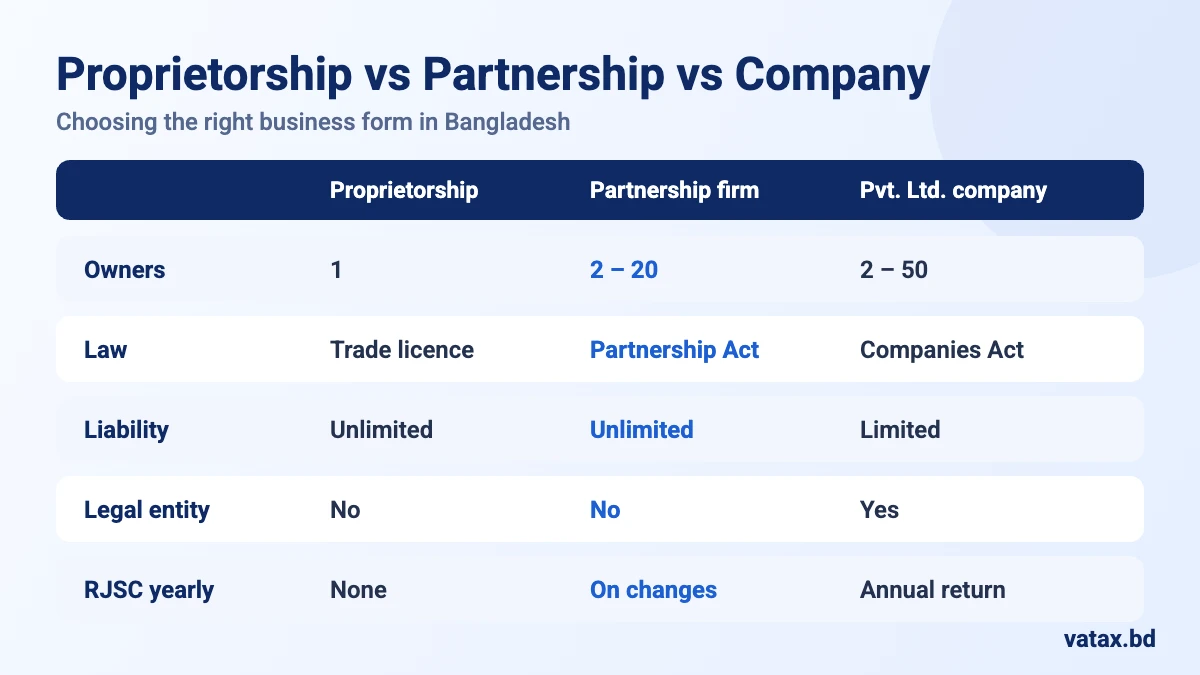
If you plan to raise investment or bring in foreign shareholders, a company is usually better. See our company registration guide and RJSC fee calculator.
Changes, new partners and dissolution
A registered firm should keep its RJSC record up to date. When the firm name, principal place of business or branches change, when a partner joins or retires, or when the firm is dissolved, the change should be notified to RJSC in the prescribed form, usually with a supplementary deed signed by the partners. Keeping the record current protects outgoing partners from future liabilities and avoids problems with banks and licences.
- New partner: sign a supplementary deed, update capital and profit ratios, and notify RJSC.
- Retiring partner: agree the settlement of capital and liabilities in writing, notify RJSC, and give public notice where needed.
- Dissolution: settle accounts, close tax and VAT registrations, and notify RJSC.
Common partnership registration mistakes
- Using a template deed: generic deeds rarely cover capital, drawings, retirement or disputes properly.
- No clause on bank signing: unclear signing rules freeze bank accounts when partners disagree.
- Different names on documents: the firm name must match exactly on the deed, RJSC certificate, trade licence, TIN, BIN and bank account.
- Not registering at all: an unregistered firm cannot sue on its contracts under section 69.
- Ignoring tax and VAT after registration: the firm must file its own returns; missing a BIN now blocks bank accounts and licence renewals.
How VATax helps you register a partnership firm
VATax Advisory & Co. handles the whole process: name clearance, drafting a protective partnership deed, stamp paper and execution, online Form I filing, RJSC follow-up, and the trade licence, e-TIN, BIN and bank account after registration. A tax lawyer reviews every deed, so the tax and VAT position of the firm is right from day one.
বাংলায় সংক্ষেপে: অংশীদারি ফার্ম নিবন্ধন
অংশীদারি আইন, ১৯৩২ অনুযায়ী দুই বা ততোধিক ব্যক্তি মিলে মুনাফা ভাগাভাগির জন্য যে ব্যবসা পরিচালনা করেন, তাকে অংশীদারি ফার্ম বলে। ফার্ম নিবন্ধন করে যৌথমূলধনী কোম্পানি ও ফার্মসমূহের পরিদপ্তর (RJSC)। নিবন্ধন বাধ্যতামূলক নয়, তবে ধারা ৬৯ অনুযায়ী অনিবন্ধিত ফার্ম চুক্তিগত অধিকার আদায়ে তৃতীয় পক্ষের বিরুদ্ধে মামলা করতে পারে না।
- অংশীদার: ন্যূনতম ২ জন, সর্বোচ্চ ২০ জন (ব্যাংকিং ব্যবসায় ১০ জন)।
- ধাপ: নামের ছাড়পত্র → অংশীদারি দলিল প্রস্তুত → নন-জুডিশিয়াল স্ট্যাম্পে সকল অংশীদারের স্বাক্ষর → অনলাইনে ফরম-১ দাখিল → ফি পরিশোধ → নিবন্ধন সনদ।
- নামের ছাড়পত্র ফি: প্রতি নামে ৫০০ টাকা (RJSC ফি তালিকা অনুযায়ী)।
- নিবন্ধনের পর: ট্রেড লাইসেন্স, ফার্মের ই-টিআইএন, BIN বা তালিকাভুক্তি সনদ এবং ফার্মের নামে ব্যাংক হিসাব।
ভ্যাটক্স অ্যাডভাইজরি অ্যান্ড কোং নামের ছাড়পত্র থেকে শুরু করে দলিল প্রস্তুত, RJSC নিবন্ধন এবং ট্রেড লাইসেন্স, টিআইএন ও BIN পর্যন্ত সব কাজ করে দেয়। যোগাযোগ: +৮৮০ ১৭১৩-৫৬০০৬৫।
Partnership firm registration FAQ
Is partnership firm registration mandatory in Bangladesh?
How many partners can a partnership firm have?
Which authority registers partnership firms?
Which form is used for partnership registration?
How much does partnership firm registration cost?
Can a foreigner be a partner in a Bangladeshi partnership firm?
Does a partnership firm need a BIN?
Is a partnership firm a separate legal entity?
Does a partnership firm file its own income tax return?
How long does partnership firm registration take?
Register your partnership firm the right way
From name clearance to the RJSC certificate, trade licence, TIN and BIN, VATax Advisory & Co. handles it for you.
References: Partnership Act, 1932 (including sections 58 and 69); Companies Act, 1994; Stamp Act, 1899; RJSC fee schedule; Finance Act 2026. Fees and stamp values can change; confirm before payment. This guide is general information, not legal advice for a specific case.