
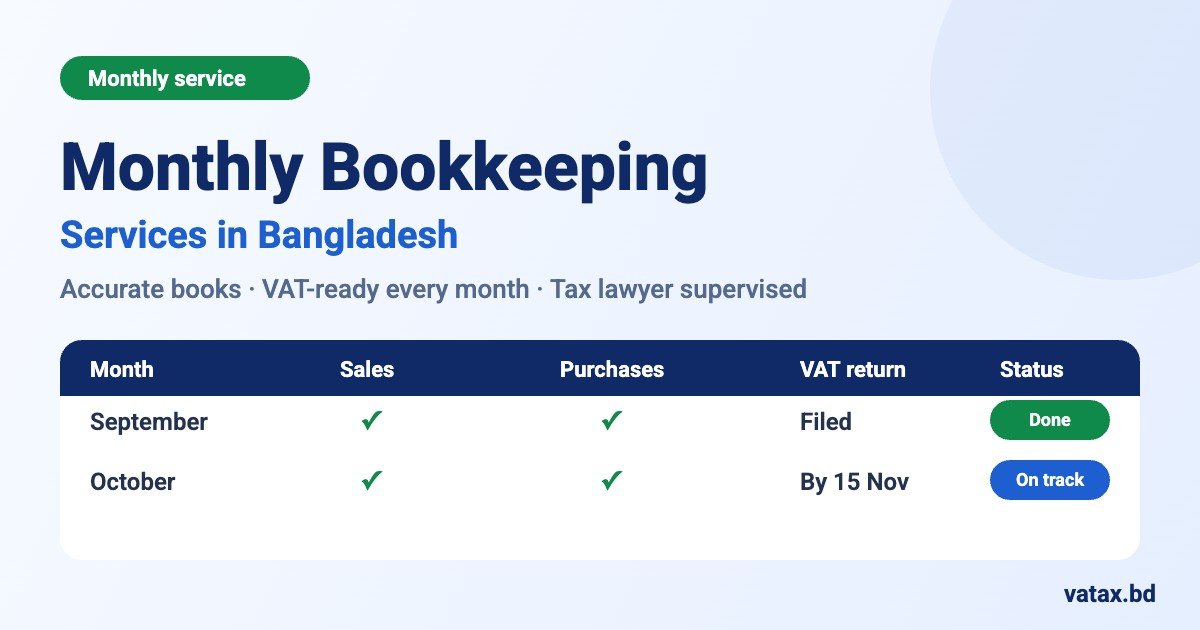
Monthly bookkeeping services in Bangladesh keep your books accurate, VAT-ready and audit-ready every single month. VATax Advisory & Co. records your sales, purchases, bank transactions and payroll, keeps your Mushak registers up to date, prepares your monthly VAT return and gives you a clear report before you need it.
- Why monthly bookkeeping matters
- What our monthly bookkeeping includes
- Our monthly bookkeeping cycle
- What you send us each month
- What you receive
- VAT records you must keep
- Catch-up bookkeeping
- Year-end benefits
- Who it is for
- Bookkeeping vs in-house accountant
- Common bookkeeping mistakes we fix
- How to start
- বাংলায় সংক্ষেপে
- FAQ
Why monthly bookkeeping matters in Bangladesh
Many small and medium businesses in Bangladesh keep their accounts only when the tax return or audit is due. By then, invoices are missing, bank entries cannot be explained, and VAT returns filed during the year do not match the books. Monthly bookkeeping fixes this at the source.
- VAT returns are monthly again. From 1 October 2026, VAT returns are due for every month, within 15 days after the month ends for most businesses. Your purchase and sales records must be ready on time every month.
- Input tax credit needs proof. You can claim credit only for purchases supported by a valid tax invoice (Mushak 6.3) and recorded properly. Monthly bookkeeping makes sure no valid credit is lost.
- Withholding tax is checked closely. TDS and VDS must be deducted, deposited and documented correctly. A short deduction can become your own liability.
- Banks ask for clean records. Loans, LC limits and renewals are easier when your bank statements match your books and your BIN and returns are in order.
- Better decisions. A monthly report shows what you earned, what you spent, what customers owe you and what you owe suppliers, while there is still time to act.
What our monthly bookkeeping service includes
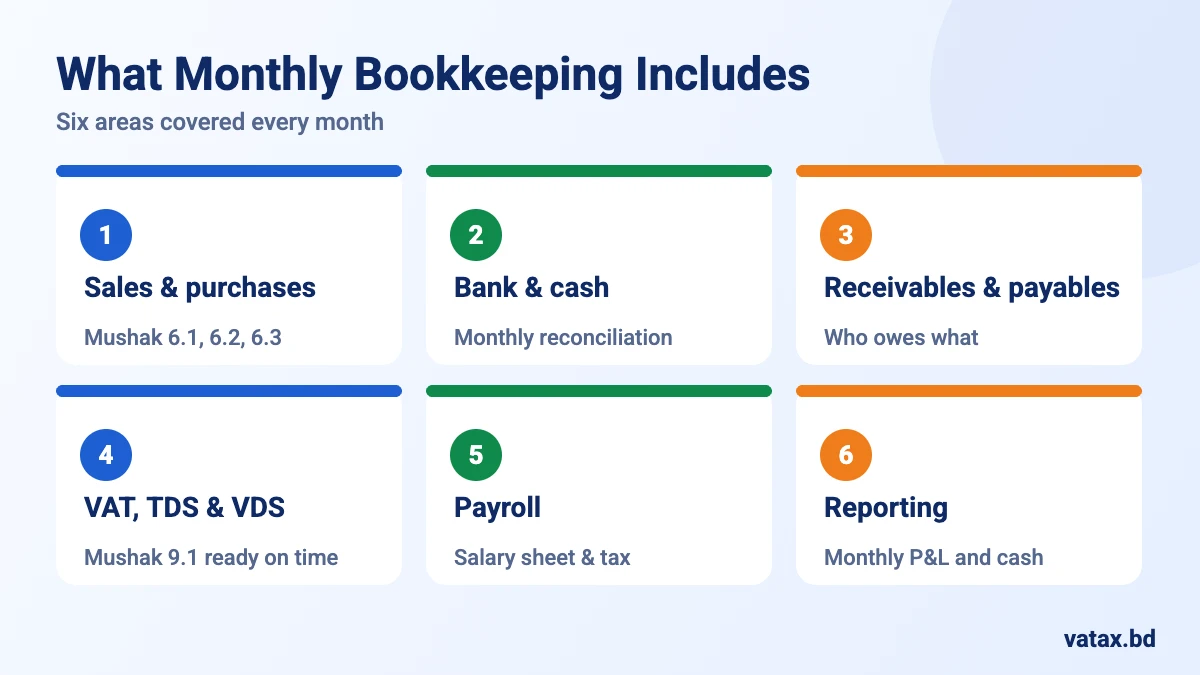
Sales and purchases
- Recording every sales and purchase invoice
- Sales register (Mushak 6.2) and purchase register (Mushak 6.1)
- Checking tax invoices (Mushak 6.3) for input credit
Bank and cash
- Monthly bank reconciliation for every account
- Cash book and petty cash
- Clearing unexplained entries with you
Receivables and payables
- Customer balances and ageing
- Supplier balances and due dates
- Advance and loan accounts
VAT, TDS and VDS
- Monthly VAT return (Mushak 9.1) preparation
- TDS and VDS records and certificates
- VDS certificates (Mushak 6.6) received and issued
Payroll
- Monthly salary sheet
- Tax deduction from salary
- Payroll records for the year-end return
Reporting
- Monthly profit and loss
- Balance sheet and cash summary
- Year-end file ready for audit and tax return
Our monthly bookkeeping cycle
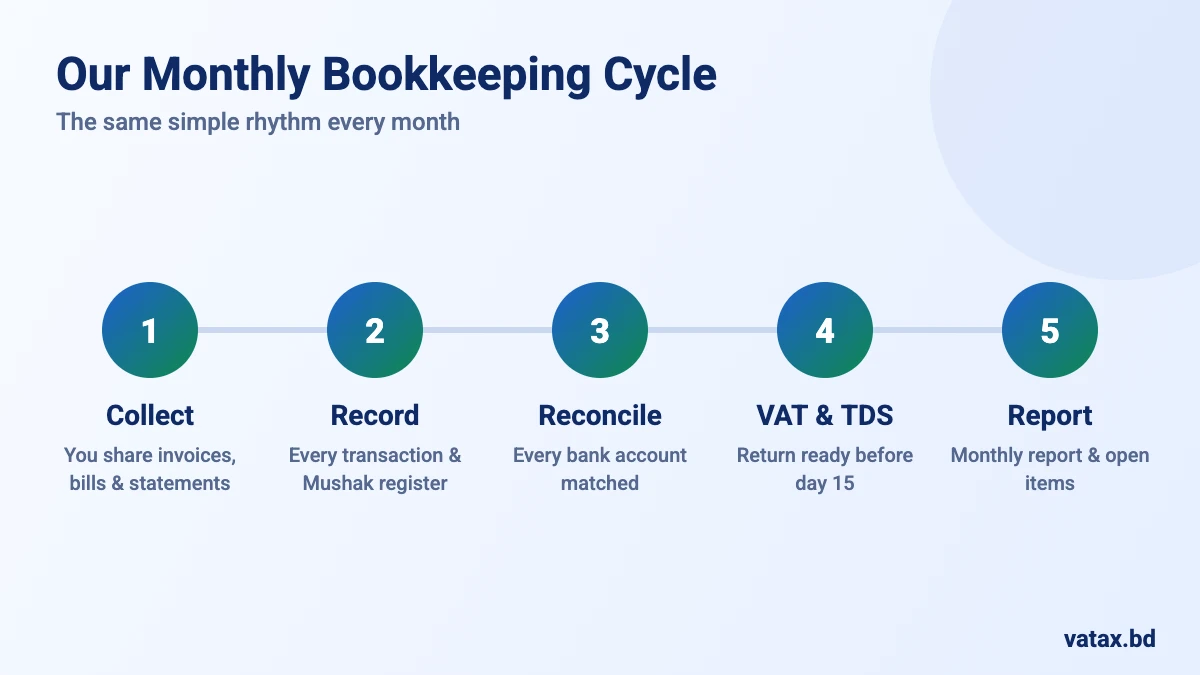
Every month follows the same simple rhythm, so you always know what happens next. The exact days are agreed with you at the start.
- Collect. In the first days of the month, you share last month's invoices, bills, bank statements and payroll through a shared folder, email or WhatsApp.
- Record. We record every transaction, update the Mushak registers and match purchases with valid tax invoices.
- Reconcile. We reconcile every bank account and list any entry that needs your explanation.
- VAT and withholding. We prepare the monthly VAT return with all credits and adjustments, and check TDS and VDS, so the return can be filed before the 15-day deadline.
- Report. You receive a short monthly report and a list of open items, and we answer your questions.
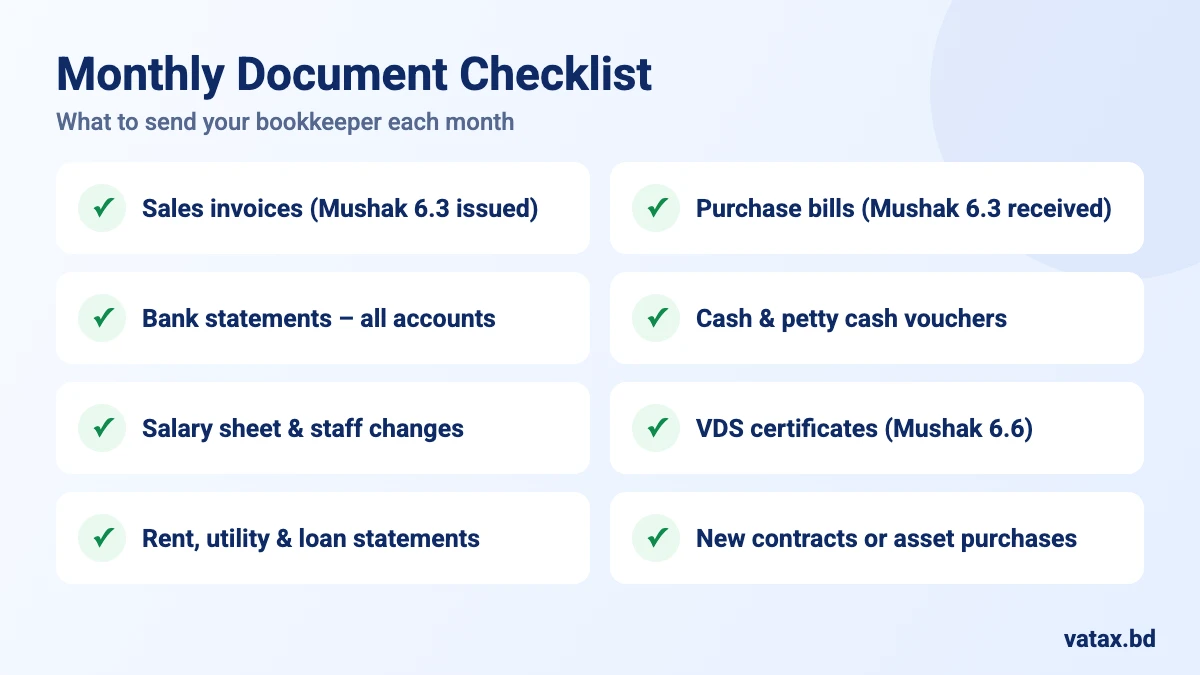
What you send us each month
- Sales invoices and Mushak 6.3 tax invoices issued
- Purchase bills and Mushak 6.3 tax invoices received
- Bank statements for every business account
- Cash vouchers and petty cash records
- Salary sheet and staff changes
- VDS certificates (Mushak 6.6) and TDS challans
- Rent, utility and loan statements
- Any new contract, loan or asset purchase
What you receive every month
| Deliverable | Why it matters |
|---|---|
| Updated books of account | One reliable record for tax, VAT, audit and bank |
| Mushak 6.1 and 6.2 registers | Required VAT records, ready for any VAT visit |
| VAT return working (Mushak 9.1) | Correct VAT payable and credit, filed on time |
| Bank reconciliation | Every bank entry explained |
| TDS and VDS summary | Withholding deducted, deposited and documented |
| Monthly report | Profit, cash, receivables and payables at a glance |
| Open items list | What we still need from you, in one place |
Bookkeeping and the VAT records you must keep
The VAT & SD Act 2012 expects every registered business to keep proper records of its supplies and purchases, and section 107 sets out the duty to maintain records and accounts. In practice, a VAT officer checking your business will usually ask for:
- the purchase register (Mushak 6.1) and sales register (Mushak 6.2), or the combined register used by some traders;
- copies of every tax invoice issued and received (Mushak 6.3);
- credit and debit notes for returns and price changes;
- VDS certificates (Mushak 6.6) and treasury challans;
- the monthly VAT returns and the working behind each figure;
- bank statements that support the payments and receipts.
Our monthly bookkeeping keeps all of these in one organised file. When a VAT visit, audit or bank enquiry comes, the answers are already there.
Catch-up bookkeeping for books that are behind
If your books are several months or even a year behind, we start with a catch-up project. We collect bank statements and available invoices, rebuild the registers month by month, reconcile the banks, and list any VAT or withholding issues we find, such as purchases without valid invoices or months where the VAT return does not match the records. You then decide, with our advice, how to correct them. Once the books are current, the regular monthly cycle begins.
Monthly bookkeeping for foreign-owned companies and offices
Foreign-owned companies, branch offices and liaison offices often need clean monthly figures in English for their head office, as well as local VAT and tax compliance. We keep the books to Bangladesh requirements and prepare a clear monthly summary in English, so both the head office and the local authorities see the same reliable numbers. Our team can also coordinate with your auditors at year end.
How monthly bookkeeping helps at year end
At the end of the income year, a company needs audited financial statements and an income tax return, and every business needs its figures for the return. When the books have been kept every month, the year-end work is mostly review rather than reconstruction. The auditor receives organised ledgers and reconciliations, the tax return uses figures that already match the VAT returns, and you avoid last-minute pressure and extra professional fees.
Who our monthly bookkeeping is for
- Small and medium businesses that do not need a full-time accountant but want clean books every month.
- Startups and new companies that want to set up proper records from day one.
- Foreign-owned companies, branch and liaison offices that need reliable monthly reporting to their head office.
- Traders, manufacturers and service providers registered for VAT who must file a return every month.
- Businesses behind on their books that need catch-up bookkeeping before an audit, tax return or bank renewal.
Industries we keep books for
Every industry has its own VAT and withholding issues, so bookkeeping must follow the business, not just the template. We regularly work with:
- Trading and import businesses: purchase records linked to import documents, stock movement and VAT on resale.
- Manufacturers: raw material purchases, production records that support the Mushak 4.3 price declaration, and VAT on supplies.
- Service providers and consultants: service invoices, VDS deducted by clients and TDS on fees.
- IT and software companies: foreign receipts through banks, local sales and VAT on services.
- Restaurants and retail shops: daily sales summaries, purchase records and monthly VAT.
What makes VATax monthly bookkeeping different
- Tax lawyer supervision: books are kept with an eye on VAT and income tax law, not only on debits and credits.
- VAT-first approach: every purchase is checked for a valid tax invoice so you keep the input credit you are entitled to.
- Clear monthly communication: one short report and one open-items list each month, in plain language.
- One team for everything: bookkeeping, VAT returns, withholding tax, income tax returns and RJSC filings can all be handled together.
Month-end checklist for business owners
- Collect every sales and purchase invoice for the month.
- Ask suppliers for a proper tax invoice (Mushak 6.3) for each VATable purchase.
- Download bank statements for all business accounts.
- Note any cash payments, owner drawings or loans.
- Share everything with your bookkeeper in the first days of the next month.
Monthly bookkeeping service vs an in-house accountant
| VATax monthly bookkeeping | One in-house accountant | |
|---|---|---|
| Cost | A monthly fee agreed with you | Full salary, benefits and office cost |
| Expertise | Bookkeeper backed by a tax lawyer and VAT consultant | Depends on one person |
| VAT and tax updates | Built into the service | Needs separate training |
| Leave and turnover | No break in service | Work stops when the person leaves |
| Year-end | Books ready for audit and return | Often needs outside help anyway |
If you need someone working on your accounts on fixed days each week, see our monthly accounting retainer.
Common bookkeeping mistakes we fix
- Purchases without a tax invoice. Credit is lost and VAT costs more than it should.
- VAT return figures that do not match the books. This is the first thing a VAT audit checks.
- Cash payments to suppliers. Under the 2026-27 rules, payments outside the banking channel can attract a 50% higher TDS rate.
- Personal and business money mixed. Unexplained bank entries create tax questions.
- Missing VDS certificates. Without Mushak 6.6, the VAT deducted by your customers cannot be adjusted.
- Books written only at year end. Errors are found too late to fix.
How to start monthly bookkeeping with VATax
- Meeting. We learn about your business, transactions and current records.
- Review. We check your existing books, VAT returns and bank accounts and list what needs fixing.
- Proposal. You receive a clear scope and a monthly fee based on your volume.
- Onboarding. We set up the chart of accounts, registers and a shared folder.
- Monthly service. The monthly cycle starts, and you get your first report.
Related services: accounting retainer · VAT registration · TDS & VDS rate chart 2026-27 · corporate tax advisory
Monthly bookkeeping glossary
- Bookkeeping: recording every business transaction in an organised way, every month.
- Bank reconciliation: matching the bank statement with your books so every entry is explained.
- Mushak 6.1 and 6.2: the VAT purchase and sales registers that registered businesses keep.
- Mushak 6.3: the VAT tax invoice that supports input tax credit.
- Mushak 9.1: the monthly VAT return form.
- TDS and VDS: income tax and VAT deducted at source from payments, which must be deposited and documented.
- Receivables and payables: money your customers owe you, and money you owe your suppliers.
- Input tax credit: the VAT you paid on business purchases that you can set off against the VAT on your sales, when the purchase is supported by a valid tax invoice and the other conditions in the law are met.
- Chart of accounts: the list of account headings, such as sales, rent, salary and bank, that keeps every transaction in the right place.
বাংলায় সংক্ষেপে: মাসিক বুককিপিং সেবা
মাসিক বুককিপিং মানে প্রতি মাসে আপনার ব্যবসার সব বিক্রয়, ক্রয়, ব্যাংক লেনদেন ও বেতনের হিসাব হালনাগাদ রাখা। ১ অক্টোবর ২০২৬ থেকে ভ্যাট রিটার্ন আবার মাসিক হয়েছে এবং সাধারণত মাস শেষের ১৫ দিনের মধ্যে দাখিল করতে হয়, তাই প্রতি মাসে হিসাব প্রস্তুত থাকা জরুরি।
- ক্রয় হিসাব (মূসক-৬.১) ও বিক্রয় হিসাব (মূসক-৬.২) হালনাগাদ
- মূসক-৬.৩ চালান যাচাই করে উপকরণ কর রেয়াত নিশ্চিত করা
- প্রতি মাসে ব্যাংক হিসাব মিলানো (ব্যাংক রিকনসিলিয়েশন)
- মাসিক ভ্যাট রিটার্ন (মূসক-৯.১) প্রস্তুত এবং উৎসে কর ও উৎসে ভ্যাটের হিসাব
- বেতন শিট ও বেতন থেকে কর কর্তনের হিসাব
- প্রতি মাসে সংক্ষিপ্ত আর্থিক প্রতিবেদন
ভ্যাটক্স অ্যাডভাইজরি অ্যান্ড কোং-এ একজন কর আইনজীবী ও ভ্যাট পরামর্শকের তত্ত্বাবধানে এই কাজ করা হয়। বিস্তারিত জানতে যোগাযোগ করুন: +৮৮০ ১৭১৩-৫৬০০৬৫।
Monthly bookkeeping FAQ
What is included in monthly bookkeeping services?
How much do monthly bookkeeping services cost in Bangladesh?
Do you file the monthly VAT return?
Can you work with my existing accounting software?
Do I need to send original documents?
Can you fix books that are months behind?
What is the difference between bookkeeping and an accounting retainer?
Is my financial information kept confidential?
Which businesses need monthly bookkeeping the most?
How long do I need to keep my records?
Get clean, VAT-ready books every month
Talk to VATax Advisory & Co. about monthly bookkeeping for your business. We will explain how it works in a short meeting.
References: VAT & SD Act 2012 and the VAT & SD (Amendment) Ordinance 2026 (monthly returns); Income Tax Act 2023 and Tax Deducted at Source Rules 2026; National Board of Revenue. This page describes our service and general rules; it is not legal advice for a specific case.