
VAT registration gives your business a BIN (Business Identification Number) and lets you charge VAT, claim input tax credit, open business bank accounts and renew your trade licence. This guide explains who needs VAT registration in Bangladesh, the turnover limits for 2026-27, the documents, the free online process on vat.gov.bd, and what you must do after you get your BIN.
What is VAT registration in Bangladesh?
VAT registration is the process by which the National Board of Revenue (NBR) records a business as a VAT-registered person under the VAT and Supplementary Duty Act 2012. After VAT registration, the business receives a Business Identification Number (BIN) and a registration certificate in form Mushak 2.3.
The BIN is your VAT identity. It appears on every tax invoice (Mushak 6.3), on your monthly VAT return and on customs documents. Without it you cannot legally charge 15% VAT or claim input tax credit on your purchases.
Who must take VAT registration in Bangladesh?
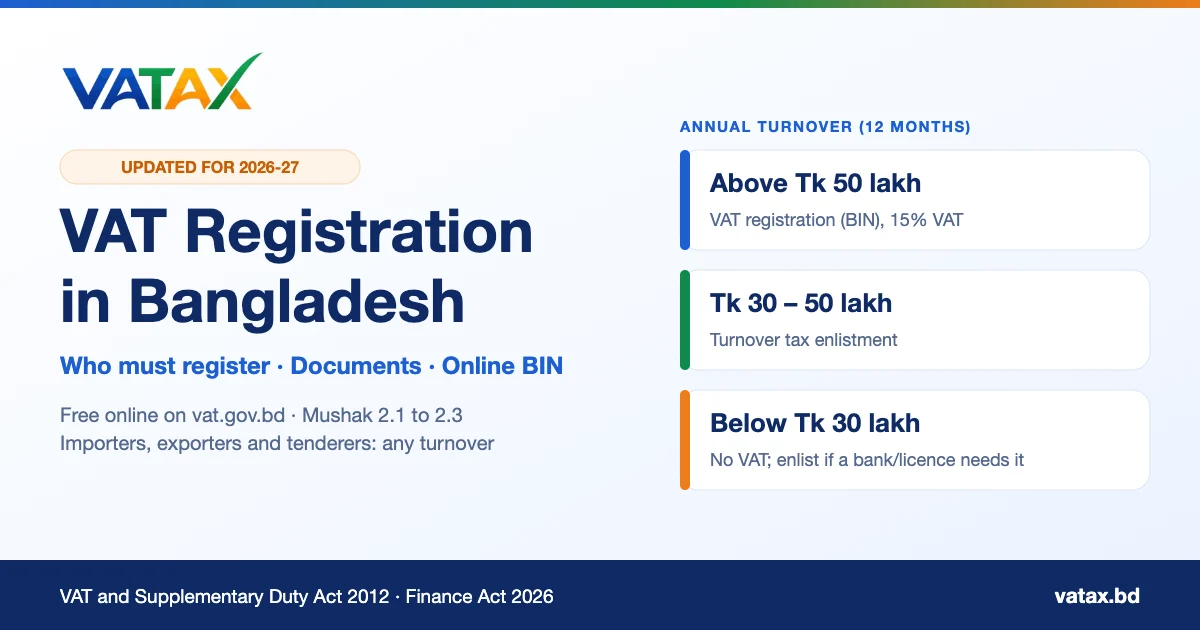
The duty to register depends on two things: your annual turnover and your type of business. Turnover means the total value of your taxable supplies over 12 months (actual or expected).
| Annual turnover (12 months) | What you need | Tax you pay |
|---|---|---|
| Above Tk 50 lakh | VAT registration (BIN) | Standard 15% VAT (or the reduced rate for your goods or services), with input tax credit |
| Tk 30 lakh to Tk 50 lakh | Turnover tax enlistment | 4% turnover tax, or a fixed yearly amount notified by NBR for your sector (maximum Tk 2 lakh); no input credit |
| Up to Tk 30 lakh | No registration needed | No VAT; enlist if a bank, MFS merchant account or licence asks for it |
Registration is required at any turnover for
- Importers and exporters
- Businesses that manufacture, import or supply goods or services subject to supplementary duty (SD)
- Businesses taking part in tenders, quotations or contracts with government, semi-government, autonomous bodies and large organisations
- Other categories listed in section 4(2) of the Act and NBR orders
A business below the threshold can also apply for voluntary VAT registration. This is useful if your buyers are VAT-registered companies that want a Mushak 6.3 invoice so they can claim input tax credit.
Read the exact legal text in Section 4: persons required to be registered for VAT.
Do I need VAT registration? Quick checker
Enter your expected turnover for the next 12 months (or the last 12 months) and tick what applies to you.
This checker is a guide only. Some sectors have special rules; ask us if you are unsure.
Documents required for VAT registration
The application is online, so you upload scanned copies. Keep these ready before you start:
Proprietorship
- Owner's NID and photo
- Trade licence
- e-TIN certificate
- Bank account details
- Rent agreement or ownership deed of the premises
Limited company
- Certificate of Incorporation
- Memorandum and Articles
- Company e-TIN and trade licence
- NID or passport of directors
- Board resolution, bank details, premises documents
Importer, exporter, factory
- IRC and/or ERC
- Factory address and list of products
- Machinery or production details
- Fire licence and environmental clearance where required
- Plus the company or proprietor documents
How to apply for VAT registration online (step by step)
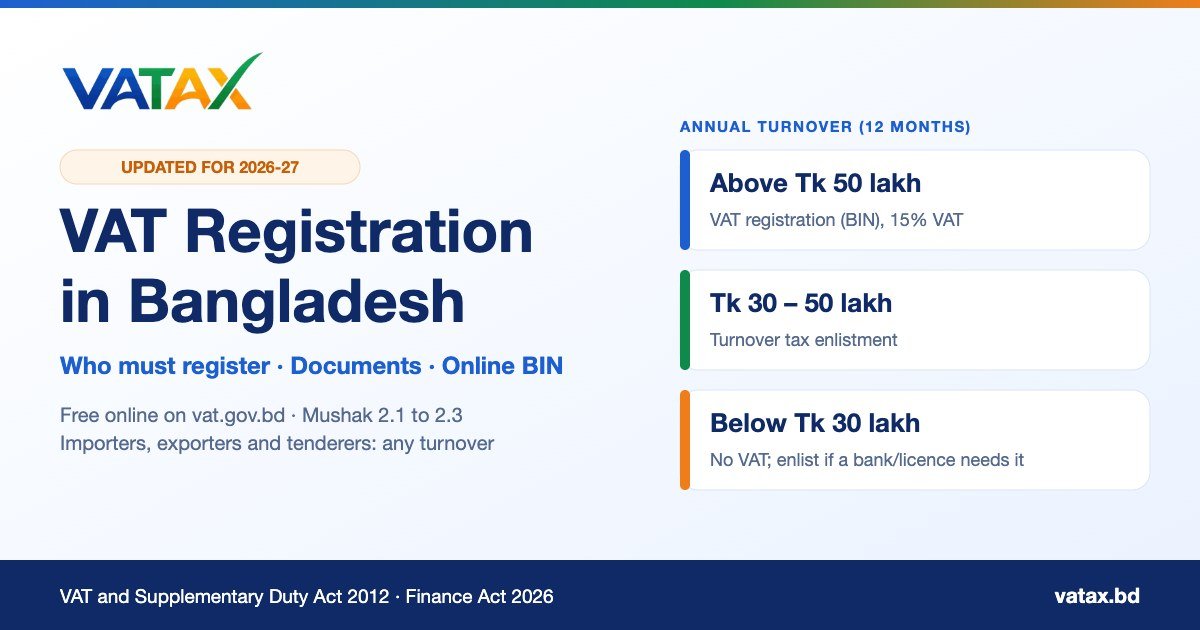
- Prepare documents listed above, and keep the owner's mobile number (linked to the NID) at hand.
- Sign up on the e-VAT portal at vat.gov.bd using the mobile OTP and NID or passport details.
- Fill in form Mushak 2.1 (application for VAT registration or turnover tax enlistment): business type, owners, address, bank account, major economic activity, import/export and other details.
- Upload documents and submit. It is free; there is no government fee.
- Receive your BIN and Mushak 2.3 certificate online. Download, print and display the certificate at your place of business.
Want screenshots of every screen? See our step-by-step guide on how to get a BIN certificate, and the legal procedure in Section 6: VAT registration procedure.
When to apply
- New business in a mandatory category (importer, exporter, tender participant, SD goods): before you start supplies.
- Existing business crossing Tk 50 lakh: within 15 days after turnover crosses the threshold. Registration takes effect from the first day of that month, and VAT is payable from that date even if you register late.
- Turnover tax enlistment (Tk 30–50 lakh): within 30 days after the 12-month period in which you crossed Tk 30 lakh.
Central VAT registration for multiple branches (Section 5)
If your business supplies the same or similar goods or services from several branches, factories or outlets, you can choose central VAT registration instead of a separate BIN for each unit. Section 5 of the VAT and Supplementary Duty Act 2012 allows this when:
- you supply identical or similar goods or services (or both) from one or more places;
- all accounts, tax payments and records are kept centrally in software-based automated systems; and
- you meet the conditions set by NBR.
Under central VAT registration, moving goods or services between your own units is not a supply, so there is no output VAT or input credit on the transfer; the movement is recorded on Mushak 6.5. If any unit keeps separate accounts, or units supply different kinds of goods or services, each unit needs its own BIN. Central registration is not available for tobacco products supplied under the special scheme in section 58.
Read Section 5 of the VAT Act (English)
(1) If any person, from one or multiple locations, maintains all accounts, tax payments, and records related to the supply of identical or similar goods or services (or both) through a software-based automated system in a centralized manner, they may obtain a central VAT registration in accordance with the prescribed conditions and procedures.
Provided that, even if identical or similar goods or services are supplied, if accounts, tax payments, and records are maintained separately for any unit, then separate registration must be obtained for each unit.
(1a) Notwithstanding anything contained in sub-section (1), central registration shall not apply in the case of supplying tobacco products under a special scheme pursuant to Section 58.
(1b) The Board may formulate rules for obtaining central registration and for the payment of tax.
Note:
The conditions for central registration include:
Supply of goods or services from one or more locations;
Centralized record-keeping through an automated system; and
Supply of identical or similar goods or services (or both).
If these conditions are fulfilled, a central VAT registration may be obtained.
Supply of Identical or Similar Goods and Services
If a company supplies air conditioners (ACs) through registered central units located in different parts of the country, it will be considered a supply of identical goods. If maintenance and operational services are also provided along with the ACs, it will be treated as a supply of identical or similar goods and services. Further details on this are discussed in the second part of the chapter on central registration.
(2) Notwithstanding anything contained in sub-section (1), if a person conducts economic activities related to the supply of different goods or services from two or more locations, they must obtain separate VAT registrations for each location.
(Note: If the conditions for central registration are not fulfilled, the entity must continue with the conventional method of obtaining separate registration. In such cases, the registered entity will fall under the jurisdiction of the VAT Commissionerate controlling that specific geographical area.)
(3) The movement or transfer of goods or services from one unit to another within a centrally registered entity under sub-section (1) shall not be considered a supply, and therefore, no output tax liability or input tax credit will arise from such transfers.
(Note: In the case of transferring goods from one unit to another within a centrally registered organization, the transfer must be documented using Form VAT 6.5, and no VAT is payable on such transfers.)
In case of conflict arises between the Bengali and English texts, the Bengali text shall prevail.
ধারা ৫: কেন্দ্রীয় নিবন্ধন (বাংলা মূল পাঠ)
(১) যদি কোন ব্যক্তি এক বা একাধিক স্থান হইতে অভিন্ন অথবা সমজাতীয় পণ্য বা সেবা বা উভয়ই সরবরাহ সংক্রান্ত অর্থনৈতিক কার্যক্রমের সকল হিসাব-নিকাশ, কর পরিশোধ ও রেকর্ডপত্র সফটওয়্যার ভিত্তিক অটোমেটেড পদ্ধতিতে কেন্দ্রীয়ভাবে সংরক্ষণ করেন, তাহা হইলে তিনি নির্ধারিত শর্ত ও পদ্ধতিতে, একটি কেন্দ্রীয় মূসক নিবন্ধন গ্রহণ করিতে পারিবেন:
তবে শর্ত থাকে যে, অভিন্ন বা সমজাতীয় পণ্য বা সেবা সরবরাহ করা সত্ত্বেও কোন ইউনিটে অর্থনৈতিক কার্যক্রমের হিসাব-নিকাশ, কর পরিশোধ ও রেকর্ডপত্র স্বতন্ত্রভাবে সংরক্ষণ করিলে তাহাকে প্রতিটি ইউনিটের জন্য পৃথক নিবন্ধন গ্রহণ করিতে হইবে।
(১ক) উপ-ধারা (১) এ যাহা কিছুই থাকুক না কেন, ধারা ৫৮ এর অধীন বিশেষ পরিকল্পের অধীন তামাকজাত পণ্য সরবরাহের ক্ষেত্রে কেন্দ্রীয় নিবন্ধন প্রযোজ্য হইবে না।।
(১খ) কেন্দ্রীয় নিবন্ধন গ্রহণ ও কর পরিশোধের লক্ষ্যে বোর্ড বিধিমালা প্রণয়ন করিতে পারিবে।।"
(কেন্দ্রীয় নিবন্ধনের শর্ত হচ্ছে এক বা একাধিক স্থান হতে পণ্য বা সেবা সরবরাহ, কেন্দ্রীয়ভাবে অটোমেটেড পদ্ধতিতে হিসাব সংরক্ষণ এবং অভিন্ন অথবা সমজাতীয় পণ্য বা সেবা বা উভয়ই সরবরাহ সংক্রান্ত অর্থনৈতিক কার্যক্রম। এসব শর্ত পরিপালিত হলে কেন্দ্রীয় নিবন্ধন গ্রহণ করা যাবে।
অভিন্ন বা সমজাতীয় পণ্য ও সেবা সরবরাহ
যদি কোনো প্রতিষ্ঠান দেশের বিভিন্ন স্থানে নিবন্ধিত কেন্দ্রীয় ইউনিটের মাধ্যমে এয়ার কন্ডিশনার (AC) সরবরাহ করে, তবে তা অভিন্ন পণ্য সরবরাহ হিসেবে গণ্য হবে। যদি সেই সরবরাহের সঙ্গে রক্ষণাবেক্ষণ ও পরিচালনা সংক্রান্ত সেবাও যুক্ত থাকে, তাহলে সেটি অভিন্ন বা সমজাতীয় পণ্য ও সেবা সরবরাহ হিসেবে বিবেচিত হবে। কেন্দ্রীয় নিবন্ধন সংক্রান্ত অধ্যায়ের দ্বিতীয় অংশে এ বিষয়ে বিস্তারিত আলোচনা করা হয়েছে।
(২) উপ-ধারা (১) এ যাহা কিছুই থাকুক না কেন, যদি কোন ব্যক্তি দুই বা ততোধিক স্থান হইতে ভিন্ন ভিন্ন পণ্য বা সেবা সরবরাহ সংক্রান্ত অর্থনৈতিক কার্যক্রম পরিচালনা করেন তাহা হইলে তাহাকে প্রতিটি স্থানের জন্য পৃথক নিবন্ধন গ্রহণ করিতে হইবে।
(কেন্দ্রীয় নিবন্ধনের শর্তপূরণ না হলে পূর্বের ন্যায় একক নিবন্ধন গ্রহণ করা যাবে। সেক্ষেত্রে একক নিবন্ধন গ্রহণকারী প্রতিষ্ঠানটি ঐ ভৌগলিক এলাকা নিয়ন্ত্রণকারী মূল্য সংযোজন কর কমিশনারেটের আওতাধীন হবে।)
(৩) উপ-ধারা (১) এর অধীন নিবন্ধিত ব্যক্তির কেন্দ্রীয় এক ইউনিট হইতে অপর ইউনিটে পণ্য বা সেবার আদান-প্রদান বা চলাচল সরবরাহ বলিয়া গণ্য হইবে না এবং ফলশ্রুতিতে উৎপাদ কর দায় বা উপকরণ কর রেয়াত উদ্ভূত হইবে না।।'
(কেন্দ্রীয় নিবন্ধিত প্রতিষ্ঠানের এক ইউনিট হতে অন্য ইউনিটে পণ্য স্থানান্তর করা হলে ফরম মূসক-৬.৫ দিয়ে স্থানান্তর করতে হবে এবং এক্ষেত্রে কোন মুসক পরিশোধ করতে হবে না।)
Your duties after VAT registration
- Issue tax invoices (Mushak 6.3) showing your BIN for every taxable supply.
- File the VAT return every month within 15 days after the month ends, even if you had no sales (a nil return). See our note on monthly VAT returns from 2026.
- Deduct VAT at source (VDS) where the law requires, and issue Mushak 6.6 certificates.
- Keep records of purchases, sales and stock (Mushak 6.1, 6.2 or 6.2.1) and keep invoices for the period set by law.
- Claim input tax credit correctly on valid invoices; read our input VAT credit guide.
- Update your VAT registration on e-VAT when your address, owners, bank account or business activity changes.
New in 2026: BIN or enlistment needed for banks, loans and licences
From 1 July 2026, the Finance Act 2026 added section 4(3) to the VAT Act. A business must now show its BIN (VAT registration) or turnover tax enlistment certificate to:
- open or operate a business current or STD account with a bank or financial institution;
- take a business loan;
- renew a trade licence;
- open a mobile financial services (MFS) merchant account;
- join or renew membership of a chamber or trade body;
- get a business electricity or gas connection; and
- register a vehicle with BRTA in the business's name.
Bangladesh Bank told all banks to apply this rule in BRPD Circular Letter No. 35 (11 October 2026). Read our full note on BIN being mandatory for bank accounts and loans. In practice, almost every business now needs either VAT registration or enlistment.
VAT registration for foreign companies and non-residents
A foreign company with a branch, liaison or project office in Bangladesh, or a foreign-owned subsidiary, follows the same rules. Because it needs a business bank account to bring in its inward remittance, it will need a BIN or enlistment in practice from day one.
A non-resident that supplies taxable goods or services into Bangladesh without a local office (for example a foreign software or streaming platform) must appoint a local VAT agent, who registers, files returns and pays VAT on its behalf.
Setting up in Bangladesh? See our guides on opening a branch office and company registration for foreign investors.
Risks of not taking VAT registration
- VAT is still due: once you cross the threshold, VAT is payable from the first day of that month, whether or not you have registered, with interest for late payment.
- Registration by the officer: the VAT officer can register you on their own initiative and assess the tax you should have paid.
- Penalties: failure to register is an offence under the VAT Act and can attract a fine; see offences and penalties under the VAT Act.
- Lost business: without a BIN you cannot bid for tenders, import, export, renew your trade licence or open a business bank account.
Changing or cancelling VAT registration
Report changes to your VAT registration details (address, owners, bank account, business activity) on the e-VAT system. If you stop business, or your turnover falls below the threshold and you are not in a mandatory category, you can apply to cancel it. You must stop issuing VAT invoices, file a final return and pay any VAT due; you may be moved to turnover tax enlistment. The legal rules are in Section 9: cancellation of VAT registration.
VAT registration: frequently asked questions
What is the VAT registration threshold in Bangladesh in 2026?
VAT registration is mandatory when annual turnover is above Tk 50 lakh. Businesses with turnover between Tk 30 lakh and Tk 50 lakh enlist for turnover tax instead. Importers, exporters, tender participants and SD goods suppliers must register at any turnover.
Is there a fee for VAT registration?
No. VAT registration and turnover tax enlistment are free and done online on the NBR e-VAT portal (vat.gov.bd).
How long does VAT registration take?
With correct documents, the online system usually issues the BIN quickly, often on the same day. Cases needing verification can take longer.
What documents are needed for VAT registration?
Usually the owner's or directors' NID or passport, trade licence, e-TIN, bank account details, premises documents and, for companies, the Certificate of Incorporation and Memorandum and Articles. Importers and exporters also need IRC or ERC.
What is the difference between BIN and TIN?
BIN is your VAT registration number issued by NBR's VAT wing. TIN is your income tax identification number. A business usually needs both.
Can a small business take VAT registration voluntarily?
Yes. Voluntary VAT registration is allowed and helps if your buyers need Mushak 6.3 tax invoices to claim input tax credit.
Do I need a separate VAT registration for each branch?
Not always. If all branches supply similar goods or services and keep accounts centrally on software, you can apply for central VAT registration under Section 5. Otherwise each branch needs its own registration.
How often must a VAT-registered business file returns?
Every month, within 15 days after the month ends, including nil returns when there were no sales.
Get your VAT registration done right
VATax Advisory & Co. handles VAT registration, turnover tax enlistment, central registration, monthly VAT returns, VDS and VAT audits for local businesses and foreign companies across Bangladesh.
Sources: VAT and Supplementary Duty Act 2012, sections 4, 5, 6 and 9 (as amended by the Finance Act 2026 and the VAT and SD (Amendment) Ordinance 2026); VAT and SD Rules 2016; National Board of Revenue; Bangladesh Bank BRPD Circular Letter No. 35 (11 October 2026). This guide is general information, not legal advice for a specific case.

