
RJSC annual return filing in Bangladesh is a yearly legal duty for every private and public limited company. After each Annual General Meeting (AGM), the company must file its RJSC annual return in Schedule X with the Registrar of Joint Stock Companies and Firms, together with its audited accounts and any event-based forms. VATax Advisory & Co. runs the full RJSC return filing cycle for local, foreign-owned and industrial companies, so your company stays in good standing every year.
- What is an RJSC annual return?
- Who must file
- RJSC compliance calendar
- What Schedule X contains
- AGM rules before filing
- Documents required
- How online RJSC return filing works
- Event-based RJSC filings
- Foreign-owned and industrial companies
- Missed returns and penalties
- RJSC return vs corporate tax return
- Our RJSC services
- বাংলায় সংক্ষেপে
- FAQ
What is an RJSC annual return?
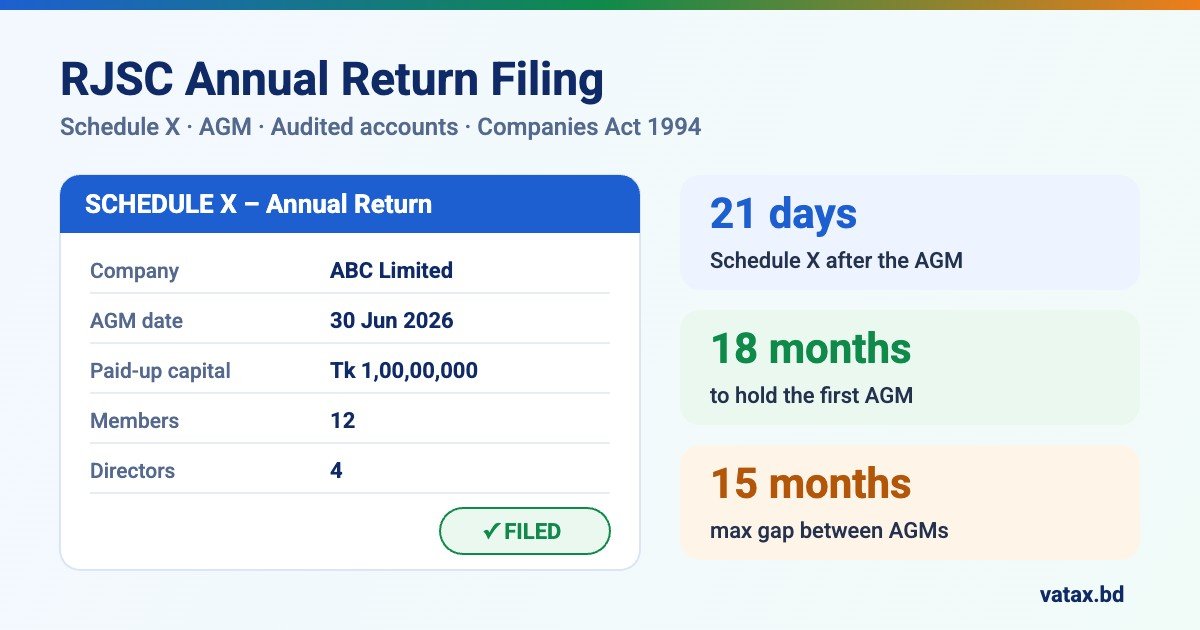
An RJSC annual return is the yearly statement a company files with the Registrar of Joint Stock Companies and Firms (RJSC) under the Companies Act, 1994. It records, as on the date of the AGM, who the members are, how many shares each holds, the company's share capital and who its directors are. The main form is Schedule X, often called the "annual list of members and summary of share capital".
The RJSC annual return is not a tax return. It does not compute profit or tax. Its purpose is to keep the public register of the company accurate, so that banks, investors, regulators and courts can rely on the RJSC file. That is why a bank asks for certified copies of the latest annual return before it approves a loan, and why BIDA, licensing bodies and foreign parent companies check the RJSC record before they act.
In practice, RJSC return filing covers more than one form. A complete yearly filing usually includes the annual return in Schedule X, the audited financial statements adopted at the AGM, the notice of the auditor's appointment and any changes during the year that were not filed at the time.
Who must file an RJSC annual return?
- Every private limited company, whether it is trading, holding assets or dormant.
- Every public limited company, listed or unlisted.
- Foreign-owned subsidiaries incorporated in Bangladesh, including companies in EPZs, Economic Zones and Hi-Tech Parks.
- One Person Companies, which follow simplified meeting rules but still keep their RJSC record up to date.
- Dormant companies with no business activity, until they are formally wound up or struck off.
Branch and liaison offices of foreign companies are not Bangladeshi companies, but they have their own RJSC filing duties, such as filing their audited accounts each year. If your business is a partnership firm, see our guide to partnership firm registration instead.
RJSC compliance calendar for the annual return
| Requirement | Form / document | Deadline |
|---|---|---|
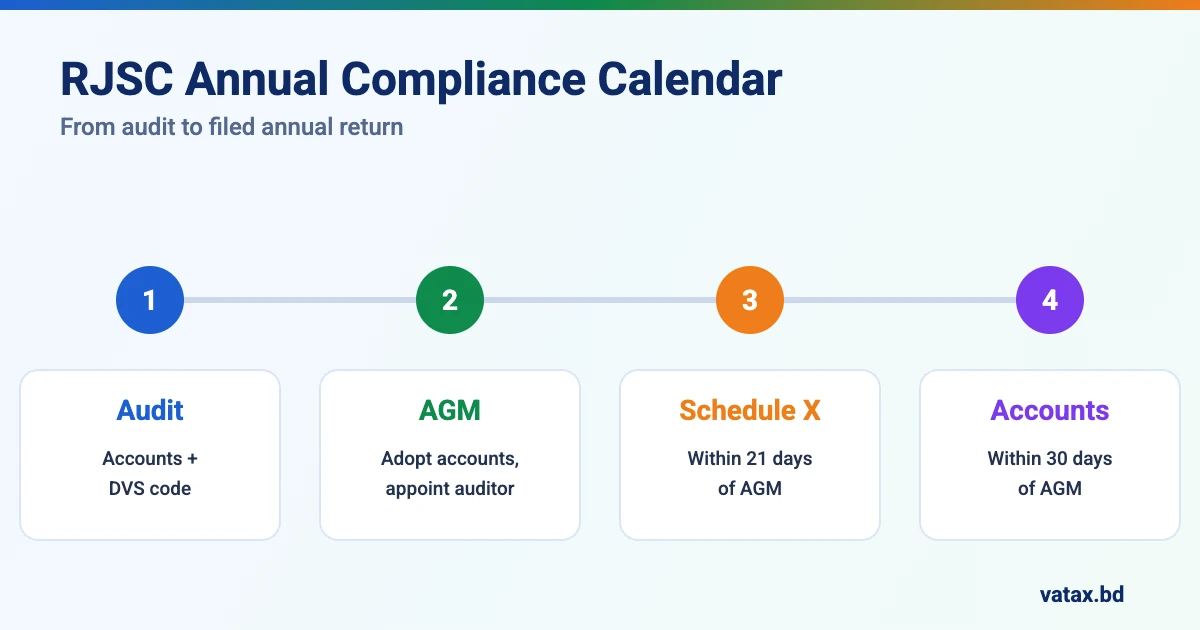
| Statutory audit | Audited financial statements with ICAB DVS code | Completed before the AGM |
| Annual General Meeting | Notice, minutes and resolutions | First within 18 months of incorporation; then every calendar year, no more than 15 months apart |
| Annual return | Schedule X (list of members and share capital summary) | Within 21 days of the AGM |
| Financial statements | Audited balance sheet and profit and loss account | Within 30 days of the AGM |
| Auditor appointment | Form 23B | After appointment at the AGM |
| Change of directors or officers | Form XII | Promptly after the change, within the statutory period |
| Allotment of new shares | Form XV (return of allotment) | Within 60 days of allotment |
| Change of registered office | Form VI | Within 28 days of the change |
Deadlines are based on the Companies Act, 1994 and RJSC practice. Your Articles of Association and later RJSC notices can affect specific dates, so we confirm each date for your company before filing.
What Schedule X contains
Schedule X is the heart of the RJSC annual return. It must match the company's own register of members exactly. A typical Schedule X shows:
- the company's name, registration number and registered office address;
- the date of the AGM to which the return relates;
- authorised, issued, subscribed and paid-up share capital;
- the number of shares allotted during the year and the amount paid on them;
- the name, address, nationality and shareholding of every member;
- shares transferred since the last return, with the names of transferors and transferees;
- particulars of directors and the managing director as on the AGM date;
- the total amount of indebtedness secured by registered charges, where required.
Most RJSC rejections and later disputes come from Schedule X figures that do not match the share register, earlier allotment returns or bank encashment records. Before any RJSC return filing, we reconcile every number in Schedule X with these sources.
AGM rules before you file the RJSC annual return
The annual return is tied to the AGM, so the meeting must be held correctly first. Key points:
- Timing. The first AGM must be held within 18 months of incorporation. After that, an AGM is held in every calendar year, with no more than 15 months between two AGMs.
- Notice. Members must receive written notice within the period set by the Act and the Articles, with the agenda and, for special business, an explanatory statement.
- Business. Ordinary business includes adopting the audited accounts, declaring any dividend, electing or re-electing directors and appointing the auditor and fixing the audit fee.
- Quorum and minutes. The meeting must have the quorum required by the Act or Articles, and signed minutes must be kept in the minute book.
- Remote participation. Foreign directors and shareholders can attend through proxies or other methods allowed by the Articles, and sign documents abroad.
Documents required for RJSC return filing
- Audited financial statements signed by the auditor, with the ICAB Document Verification System (DVS) code
- AGM notice, signed minutes and resolutions (adoption of accounts, appointment of auditor, dividend if any)
- Schedule X with the up-to-date list of shareholders and share capital
- Form 23B and the auditor's consent or appointment letter
- Board resolutions for any changes during the year
- Details of directors and shareholders, including passport details for foreign nationals
- Previous RJSC filings and certified copies, where records need to be reconciled
- Login details for the company's RJSC online account, or authority for us to file
How online RJSC annual return filing works
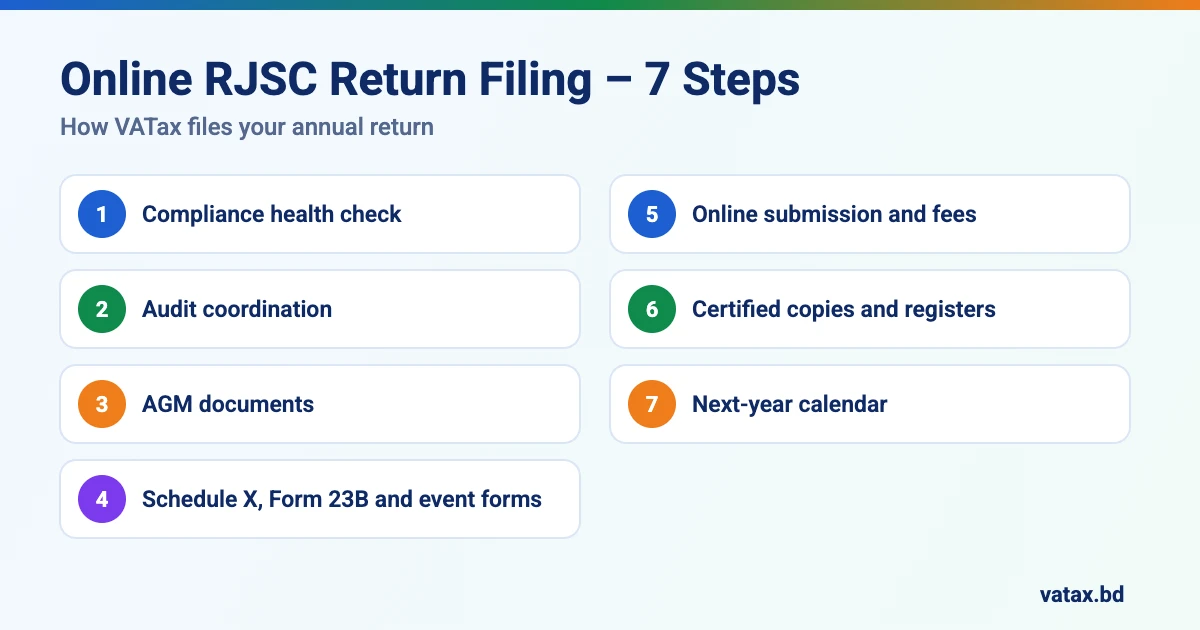
- Compliance health check. We review your RJSC file, past filings and share register and list any missing or late returns.
- Audit coordination. We work with your auditor so the financial statements and DVS code are ready before the AGM.
- AGM documents. We prepare the notice, agenda, minutes and resolutions, including formats for remote signing by foreign directors.
- Preparation of returns. We prepare Schedule X, Form 23B and any event-based forms, and check them against the share register.
- Online submission. We submit the RJSC annual return through the RJSC online system and pay the government fees.
- Certified copies. We collect the filed returns and certified copies and update your statutory registers.
- Next-year calendar. We set the next audit, AGM and filing dates so nothing is missed.
Government fees depend on the form and on the company's share capital. To estimate them before you file, use our RJSC fee calculator. Official forms and fee schedules are published by the Registrar of Joint Stock Companies and Firms.
Event-based RJSC filings during the year
The RJSC annual return only works if the changes made during the year were filed on time. These are the event-based filings we handle most often:
Directors
- Form XII for appointment, resignation or change in particulars
- Consent and qualification documents
- Board resolutions
Shares
- Form XV return of allotment
- Share transfer documents and stamp duty
- Increase of authorised capital
Company changes
- Form VI change of registered office
- Special resolutions to change name or Articles
- Registration of charges and their satisfaction
If an event was not filed when it happened, the next Schedule X will not match the RJSC record. We file the missing event forms first, then the RJSC annual return, so the record is consistent.
RJSC annual return for foreign-owned and industrial companies
Foreign-owned companies
- Dividend and profit repatriation depend on up-to-date audited accounts and RJSC records.
- Work permit and visa renewals for expatriate staff often need current company documents.
- Parent companies and auditors abroad need certified RJSC records for group reporting.
- Foreign share capital must be reconciled with encashment certificates and bank records.
- Share transfers involving non-residents need the RJSC filing coordinated with banking and tax steps.
Industrial and manufacturing companies
- Banks ask for current RJSC documents for loans, LCs and working capital limits.
- Renewal of IRC, ERC, factory and sector licences depends on updated company records.
- Government tenders and large buyers ask for evidence of good standing.
- Groups with several companies need one coordinated RJSC compliance calendar.
For foreign management, we give written English status reports after each RJSC return filing, showing what was filed, when, and what is due next.
Missed RJSC annual returns and penalties
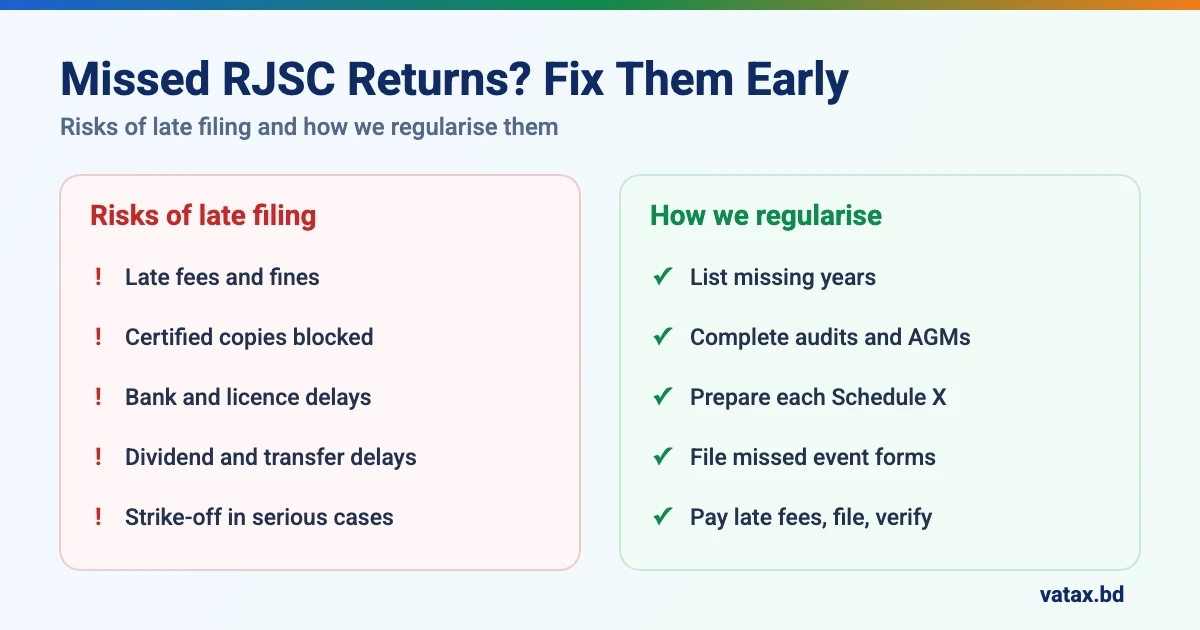
- Late fees and fines on the company and its officers for each period of default
- Difficulty getting certified copies needed by banks, BIDA and licensing authorities
- Delays in dividends, share transfers and other transactions that need current records
- Risk of the company being treated as non-compliant or defunct, and possible strike-off in serious cases
Many companies in Bangladesh have missed one or more years of RJSC annual return filing, often after a change of accountant or a period with little business. This can almost always be fixed. Our usual approach is:
- pull the RJSC file and list every missing year and event;
- complete any outstanding audits and hold or regularise the missing AGMs;
- prepare Schedule X for each year in order, so each one matches the next;
- file the event-based forms that were missed;
- pay the late fees and file all returns, then confirm the clean record with certified copies.
The sooner a company starts, the lower the late fees and the easier it is to get the documents banks and investors ask for.
RJSC return vs corporate tax return
RJSC return filing and income tax filing are separate duties, but they rely on the same audited financial statements. The RJSC annual return is filed with the Registrar under the Companies Act, 1994. The corporate tax return is filed with the National Board of Revenue under the Income Tax Act, 2023.
| Point | RJSC annual return | Corporate tax return |
|---|---|---|
| Authority | RJSC | NBR (tax circle) |
| Law | Companies Act, 1994 | Income Tax Act, 2023 |
| Main content | Members, share capital, directors (Schedule X) | Taxable income and tax payable |
| Linked to | The AGM | The income year |
| Common base | The same audited financial statements | |
We prepare and file the corporate income tax return as well, with the tax computation, withholding tax reconciliation and supporting schedules, so the RJSC and NBR filings are consistent. The standard corporate tax rate for a non-listed company remains 27.5% (25% where the banking-channel conditions are met) for FY 2026-27. We also handle the quarterly TDS return and monthly VAT returns.
Our RJSC annual return services
Annual compliance
- AGM documents
- Schedule X and Form 23B
- Filing of audited accounts
Catch-up filing
- Missed years regularised
- Late fee calculation
- Clean certified copies
Changes during the year
- Form XII, XV and VI
- Share transfers
- Charges and name changes
Why choose VATax Advisory & Co.
- Led by an NBR-enlisted Tax Lawyer with experience in company law and tax compliance
- One team for RJSC, income tax, VAT and withholding tax, so all your filings match
- Clear English communication and written status updates for foreign management
- Experience with industrial, export-oriented and foreign-owned companies
- Annual compliance calendars and reminders, so you never miss a deadline
New to Bangladesh? See our guide to company registration in Bangladesh. Want to test your company law knowledge? Try our free RJSC company law MCQ.
বাংলায় সংক্ষেপে
কোম্পানি আইন, ১৯৯৪ অনুযায়ী প্রতিটি প্রাইভেট ও পাবলিক লিমিটেড কোম্পানিকে প্রতি বছর বার্ষিক সাধারণ সভা (এজিএম) করতে হয় এবং এজিএমের ২১ দিনের মধ্যে আরজেএসসিতে শিডিউল-X বার্ষিক রিটার্ন দাখিল করতে হয়। প্রথম এজিএম নিবন্ধনের ১৮ মাসের মধ্যে এবং পরবর্তী এজিএম প্রতি পঞ্জিকা বছরে, দুই এজিএমের ব্যবধান সর্বোচ্চ ১৫ মাস। নিরীক্ষিত হিসাব (ডিভিএস কোডসহ), ফর্ম ২৩বি এবং পরিচালক বা শেয়ারের পরিবর্তনের ফর্মও সময়মতো জমা দিতে হয়। ভ্যাট্যাক্স অ্যাডভাইজরি অ্যান্ড কোং বিদেশি মালিকানাধীন ও শিল্প প্রতিষ্ঠানসহ সব কোম্পানির আরজেএসসি রিটার্ন দাখিল এবং বকেয়া বছরের রিটার্ন নিয়মিতকরণে সহায়তা করে। যোগাযোগ: +৮৮০ ১৭১৩-৫৬০০৬৫।
RJSC annual return FAQ
What is the deadline for filing the RJSC annual return?
Does a foreign-owned company in Bangladesh have to file an RJSC annual return?
Does a dormant company need to file?
Can foreign directors attend the AGM from abroad?
What happens if we have missed previous years?
Is the RJSC return the same as the corporate tax return?
Can the RJSC annual return be filed online?
What is Form XII used for?
Need your RJSC annual return filed on time?
Send us your company name and year-end. We will review your RJSC record and tell you exactly what is due.
References: Companies Act, 1994 (as amended in 2020); RJSC online filing practice; Income Tax Act, 2023; Finance Act 2026. Dates, forms and fees can change; this page is general information, not legal advice for a specific company.