
Planning to set up a business in Bangladesh? This guide explains how foreign investors and overseas companies can register a company in Bangladesh: the right legal structure, ownership rules, documents, step-by-step process, timeline and post-incorporation compliance. It is written by the team at VATax Advisory & Co., a Dhaka-based tax, VAT and corporate compliance firm led by an NBR-enlisted Tax Lawyer.
Key facts at a glance
- Foreign ownership: 100% foreign ownership is permitted in most sectors; a local partner is generally not required.
- Most common structure: a private limited company (subsidiary) under the Companies Act, 1994.
- Shareholders and directors: at least 2 shareholders (maximum 50) and at least 2 directors; individuals or companies may be shareholders.
- Capital: there is no high statutory minimum paid-up capital for a private company, but foreign investors who need work permits for expatriate staff typically remit at least USD 50,000 as equity.
- Regulators: RJSC (company registration), BIDA (investment registration and work permits), NBR (tax and VAT) and Bangladesh Bank (foreign exchange).
- Typical timeline: around 3 to 6 weeks from name clearance to incorporation, depending on documents and fund transfer.
Why Foreign Investors Choose Bangladesh
Bangladesh is one of South Asia’s fastest-growing economies, with a large consumer market, a young workforce and a strong export base in garments, textiles, leather, pharmaceuticals, IT services and light engineering. Foreign investors benefit from legal protection under the Foreign Private Investment (Promotion and Protection) Act, 1980, repatriation of profits and capital through banking channels, and incentives in Economic Zones, EPZs and Hi-Tech Parks. For a broader overview of investment rules and incentives, see our guide to Foreign Direct Investment (FDI) in Bangladesh.
Choosing the Right Business Structure
Foreign companies usually enter Bangladesh through one of three structures. The right choice depends on whether you plan to earn revenue locally, how much control you need and your tax position.
| Structure | Best for | Main approval | Can earn local revenue? |
|---|---|---|---|
| Private limited company (subsidiary) | Most foreign investors: manufacturing, trading, services, IT | RJSC incorporation | Yes |
| Branch office | Foreign companies carrying out specific projects or contracts | BIDA permission, then RJSC registration | Yes, within approved scope |
| Liaison / representative office | Market research, coordination and promoting the parent company | BIDA permission | No, funded only by the parent |
Branch and liaison offices generally need BIDA permission, an initial inward remittance and a parent company with an established track record. For most investors, a private limited company offers the most flexibility, limited liability and a clear route to profit repatriation.
Requirements for a Foreign-Owned Private Limited Company
- Company name: a unique name cleared by RJSC, ending with “Limited” or “Ltd.”
- Shareholders: minimum 2, maximum 50. They may be foreign individuals, foreign companies or a mix of foreign and Bangladeshi shareholders.
- Directors: minimum 2, aged 18 or over. Directors may be foreign nationals and are not required to live in Bangladesh, but they must hold qualification shares if the Articles require it.
- Registered office: a physical address in Bangladesh for official correspondence. A trade licence will later require a commercial or industrial premises.
- Share capital: authorised capital (the maximum the company may issue) determines RJSC fees; paid-up capital from foreign shareholders must be remitted through a bank before incorporation.
- Business objects: the Memorandum of Association must clearly describe the company’s activities. Some sectors need additional regulatory approval.
Documents Required from Foreign Shareholders
Individual shareholders and directors
- Passport copy and a recent passport-size photograph
- Residential address, nationality, occupation and parents’ names
- Email address and phone number
- Signed consent to act as director (Form IX) and signed subscriber page
Corporate shareholders
- Certificate of incorporation, Memorandum and Articles of Association of the parent company
- Board resolution approving the investment and appointing a nominee director or authorised representative
- Details of the parent company’s ultimate beneficial owners
- Recent audited financial statements, where requested by the bank or regulator
Legalisation: documents issued outside Bangladesh usually need to be in English (or translated), notarised and legalised. Bangladesh joined the Hague Apostille Convention in 2024, so documents from other member countries can generally be apostilled; documents from non-member countries normally need attestation by the Bangladesh embassy or high commission. We confirm the exact format before you sign anything, to avoid delays.
Step-by-Step Company Registration Process in Bangladesh
- Name clearance from RJSC. We search and reserve your proposed company name online with the Registrar of Joint Stock Companies and Firms (RJSC).
- Drafting incorporation documents. We prepare the Memorandum and Articles of Association, director consents and subscriber pages, tailored to your business activities and shareholding.
- Opening a bank account in the proposed company name. A local bank opens an account for the company-in-formation to receive the foreign capital.
- Remitting paid-up capital. Foreign shareholders send the paid-up capital by bank transfer, marked as equity investment. The bank then issues an Encashment Certificate confirming receipt.
- Filing with RJSC. We submit the incorporation application, signed documents and the Encashment Certificate online and pay the government fees, which depend on authorised capital (see our RJSC fee calculator).
- Bank verification. RJSC verifies the Encashment Certificate directly with the bank.
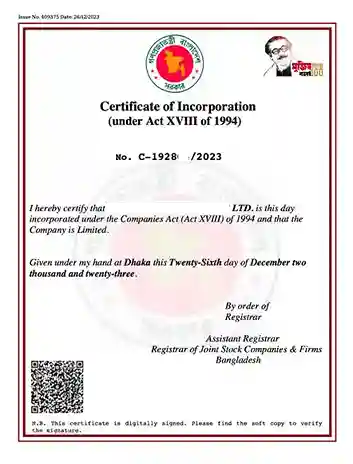
- Certificate of Incorporation. RJSC issues the Certificate of Incorporation, certified Memorandum and Articles of Association and the list of directors. The company now legally exists.
After Incorporation: Licences and Registrations
- Share certificates, statutory registers and company seal
- Trade licence from the City Corporation or local authority, renewed every year
- e-TIN (tax identification number) from the National Board of Revenue
- BIN / VAT registration for companies supplying taxable goods or services (see BIN registration and VAT return filing)
- Bank account activation for regular operations
- BIDA registration, which foreign-owned companies typically obtain for investment records, work permits and visa recommendations
- Import Registration Certificate (IRC) and Export Registration Certificate (ERC) for companies that import or export
- Sector licences such as fire licence, environmental clearance for factories, or approvals from sector regulators
- Work permits and visas for foreign directors and employees who will work in Bangladesh
Ongoing Tax and Compliance Obligations
Once operating, a foreign-owned company in Bangladesh must keep up with regular filings. Missing deadlines can lead to penalties, interest and problems when repatriating profits.
- Corporate income tax: the standard rate for a non-listed company is currently 27.5% (25% where the conditions on transactions through banking channels are met), subject to the Finance Act each year. See corporate tax return filing.
- VAT: monthly VAT returns, VAT deduction at source (VDS) and proper input-output records.
- Withholding tax: deduction of tax at source (TDS) on salaries, supplier payments, rent and payments to non-residents, with periodic withholding tax returns.
- Annual audit: accounts must be audited every year by a practising Chartered Accountant firm.
- RJSC filings: annual general meeting, annual return and filings for changes in directors, shares or registered office.
- Foreign exchange reporting: remittances, loans and dividend payments follow Bangladesh Bank rules, handled through your bank.
Typical Timeline
| Stage | Indicative time |
|---|---|
| Name clearance | 1–3 working days |
| Document drafting, signing and legalisation abroad | 1–3 weeks (depends on the investor’s country) |
| Bank account opening and capital remittance | 1–2 weeks |
| RJSC filing, bank verification and incorporation | 3–7 working days |
| Trade licence, e-TIN and BIN | 1–2 weeks |
Timelines are indicative and depend on document readiness, bank processing and government systems.
How VATax Advisory & Co. Helps Foreign Investors
We act as your single point of contact in Bangladesh, from the first consultation to full operational compliance:
- Advice on structure, shareholding and capital before you invest
- RJSC name clearance, document drafting and incorporation
- Coordination with banks for capital remittance and the Encashment Certificate
- Trade licence, e-TIN, BIN/VAT, IRC/ERC and BIDA-related registrations
- Monthly VAT, withholding tax, corporate tax and annual RJSC compliance
- Accounting and bookkeeping so your company stays audit-ready
We communicate in clear English, provide written updates at every stage, and can manage the process remotely if you are outside Bangladesh.
Ready to register your company in Bangladesh?
Speak with our team for a consultation on your structure, timeline and costs.
Book a ConsultationWhatsApp +880 1713-560065
Email: info@vatax.bd
Frequently Asked Questions
Can a foreigner own 100% of a company in Bangladesh?
Yes. In most sectors, foreign investors can own 100% of a private limited company without a local partner. A small number of sectors are restricted or need special approval.
What is the minimum capital for a foreign company in Bangladesh?
Company law does not set a high minimum paid-up capital for private companies. However, if foreign nationals need work permits, the company is typically expected to bring in at least USD 50,000 as equity. Branch and liaison offices have their own remittance requirements.
Do foreign directors need to be in Bangladesh to register a company?
No. The process can be completed remotely. Documents are signed abroad, legalised and sent to us, and the capital is transferred through the banking system.
How long does company registration take for foreign investors?
Typically 3 to 6 weeks from name clearance to the Certificate of Incorporation, depending mainly on document legalisation and fund transfer.
Is BIDA registration mandatory?
BIDA permission is required for branch and liaison offices. Foreign-owned private limited companies usually register with BIDA after incorporation, particularly when they need work permits or visa recommendations for foreign staff.
Can profits be sent back to the parent company?
Yes. After-tax profits and dividends can be repatriated through authorised banks, subject to tax deduction at source and Bangladesh Bank procedures.
What taxes will my Bangladesh company pay?
Mainly corporate income tax, VAT on taxable supplies and withholding tax on certain payments. Rates and rules are revised in the annual Finance Act, so we review your position every year.
This guide is for general information and reflects rules as of 2026. Laws, fees and procedures change; please contact us for advice on your specific situation.