
FAQ – tax, VAT and business registration in Bangladesh: clear, updated answers to the questions our clients ask most about income tax, e-TIN, return filing for FY 2026-27, VAT and BIN, IRC and ERC, company registration and foreign investment. Every answer follows the Income Tax Act 2023, the VAT & SD Act 2012 and the Finance Act 2026.
Income tax and e-TIN FAQ
What is income tax in Bangladesh?
Income tax is the tax charged on the income of individuals, firms, companies and other persons under the Income Tax Act, 2023. The National Board of Revenue (NBR) administers it. Tax is collected through returns, advance tax and tax deducted at source (TDS).
What are the heads of income under the Income Tax Act 2023?
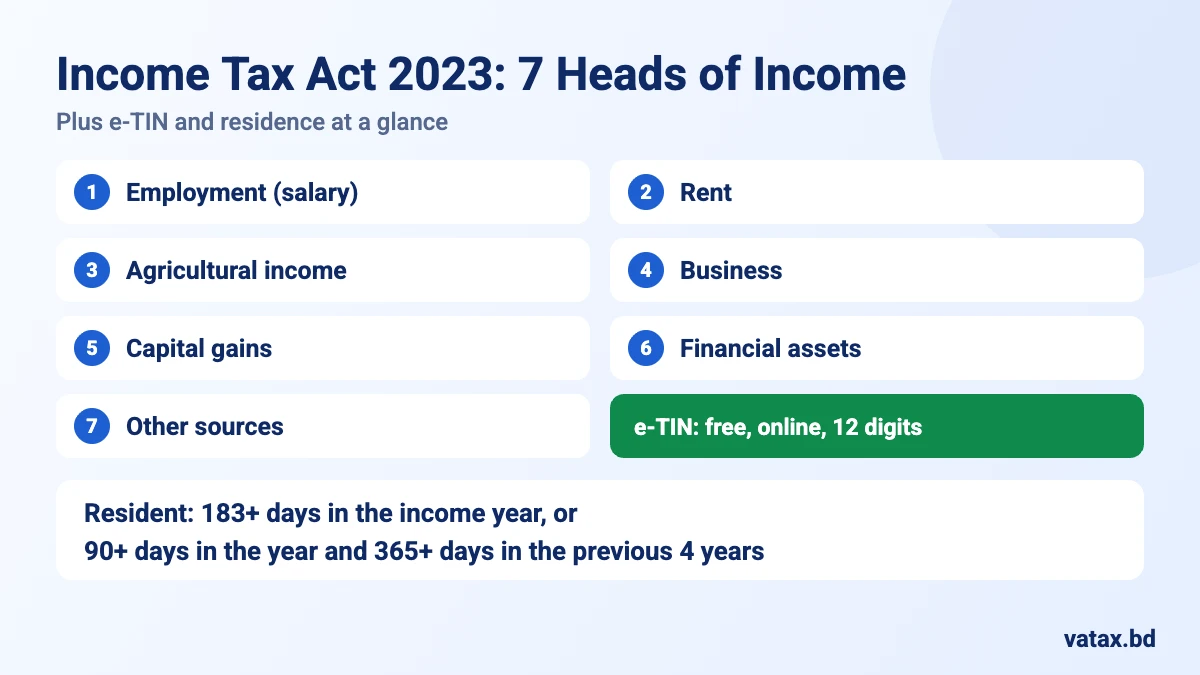
The Income Tax Act, 2023 has seven heads of income:
- Income from employment (salary)
- Income from rent
- Agricultural income
- Income from business
- Capital gains
- Income from financial assets
- Income from other sources
Each head has its own rules for allowable expenses and exemptions. The older heads used under the 1984 Ordinance (such as "interest on securities" and "house property") no longer apply.
What is income tax registration?
Under section 261 of the Income Tax Act, 2023, a person registers as a taxpayer if they are a taxpayer, must file a return under section 166, must show proof of return submission (PSR) under section 264, or want to pay tax or file a return voluntarily. Registration is done online, and NBR issues a Taxpayer Identification Number (TIN).
What is an e-TIN and how do I get one?
An e-TIN is the 12-digit electronic Taxpayer Identification Number. You can register online, free of charge, at incometax.gov.bd and download the TIN certificate immediately.
What information do I need for an e-TIN?
- Individual (adult): name, valid NID number and date of birth as in the NID.
- Foreigners or Bangladeshis without NID: passport number and issue date, visa number and issue date, and a passport-size photo.
- Company: company name, RJSC registration number and date.
- Registered firm: firm name, registration number and date.
- Unregistered firm: names and TINs of the partners.
- AOP, HUF, local authority and others: TIN of the authorised person or head.
How can I change my address, mobile number or email in my e-TIN?
Log in at incometax.gov.bd, open the Change Contact menu, update the details, write the reason in the "Update Reason" box and click Save. The new information is stored in the TIN database.
Who is a resident for income tax?
An individual is a resident for an income year if they stay in Bangladesh for 183 days or more in that year, or for 90 days or more in that year and 365 days or more in the previous four years. Residents are taxed on worldwide income; non-residents on Bangladesh-source income.
Do foreigners working in Bangladesh need to file a return?
Yes, if they have taxable income from Bangladesh. Foreign nationals usually need an e-TIN (using their passport) and a work permit. Their employer deducts tax from salary at source.
Are tax rebates available on investment?
Yes. A resident individual can get an investment tax rebate for eligible investments and expenses, such as savings instruments, life insurance premiums, contributions to approved funds and donations to approved institutions, subject to the limits in the Act. Use our tax rebate calculator to see your maximum rebate.
Income tax return FAQ (FY 2026-27)
What is an income tax return?
An income tax return is the prescribed statement in which a taxpayer reports income, expenses, assets and liabilities for an income year and pays the tax due. Individual returns are filed under the self-assessment system.
Who must file an income tax return?
Two groups must file: (a) persons with taxable income above the tax-free limit, and (b) persons who must file regardless of income, for example those who need proof of return submission (PSR) for services listed in section 264, such as a trade licence, a bank loan above the set limit or a credit card. Companies and firms must file every year.
When can individuals file the return for FY 2026-27?
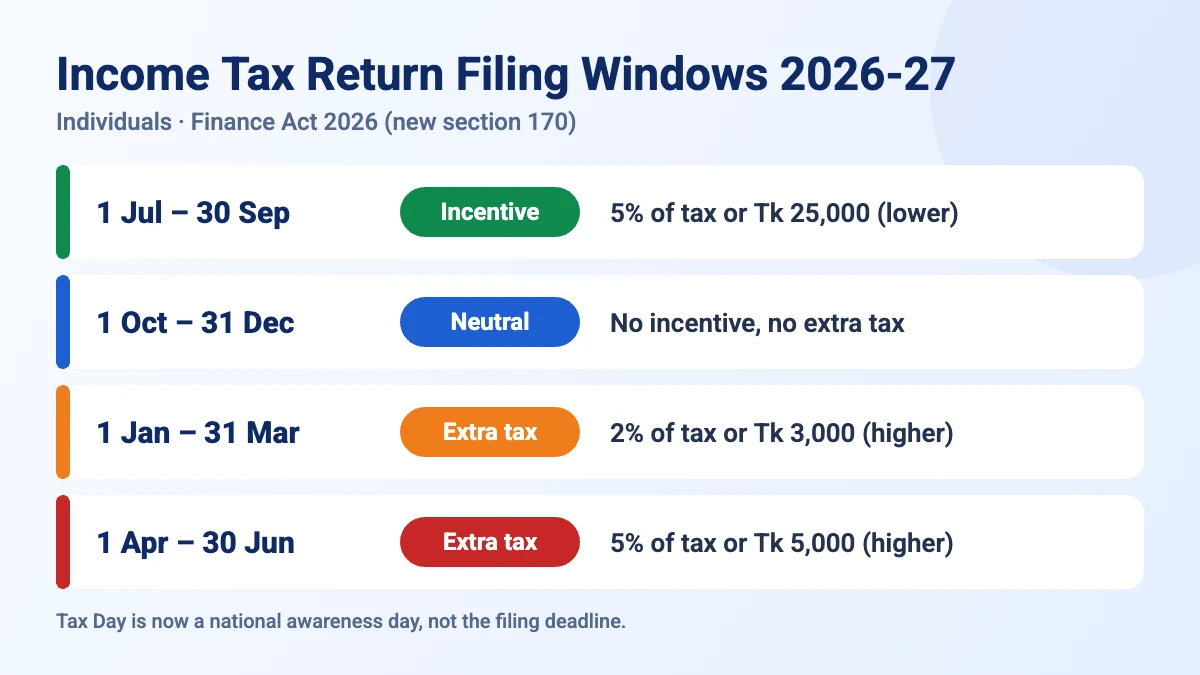
The Finance Act 2026 replaced section 170. Individuals (and Hindu Undivided Families) can now file at any time during the tax year, 1 July to 30 June, but the timing changes the cost:
- 1 July – 30 September: early-filing incentive of 5% of tax payable or Tk 25,000, whichever is lower.
- 1 October – 31 December: neutral window, no incentive and no additional tax.
- 1 January – 31 March: additional tax of 2% of tax payable or Tk 3,000, whichever is higher.
- 1 April – 30 June: additional tax of 5% or Tk 5,000, whichever is higher.
"Tax Day" is now a national awareness day and is no longer the filing deadline.
Are there special filing dates for some individuals?
Yes. A first-time individual filer who pays the applicable tax can file by 30 June following the end of the income year. A Bangladeshi abroad on a valid visa for study or work can file within 90 days after returning. If the last date is a public holiday, the next working day counts.
Is online filing mandatory?
For most individuals, yes. Under NBR Special Order 1/2026, individuals must file online through the e-Return system. Taxpayers aged 65 or above, persons with disability, Bangladeshis living abroad, representatives of deceased taxpayers and foreigners working in Bangladesh may still file on paper.
Do I have to file a return if I have no taxable income?
Yes, if you fall into a mandatory group, for example if you need PSR for a service or meet another condition in the Act. In that case you file a return showing your income and assets even if no tax is payable.
What documents do I need to file an individual return?
- TIN certificate and NID or passport
- Last year's return (copy)
- Salary statement or certificate
- Bank statements for 1 July to 30 June
- Investment papers (savings certificates, DPS, insurance, FDR)
- TDS and advance tax certificates or challans
- Rent, land, vehicle and loan documents, if any
- Trade licence for business income
Can I revise my return after filing?
Yes. Under section 180(2), a revised return can be filed within 180 days of the original return if you find an omission or mistake, as long as conditions are met. A revised return cannot reduce the tax liability shown in the original return.
What happens if I file late or do not file?
Late filing costs additional tax under the new filing windows, and returns filed after the tax year are assessed by the Deputy Commissioner of Taxes. A late filer may also lose some exemptions. Without a return you cannot obtain PSR, which you need for many services, and penalties can apply under the Act.
What is PSR and when do I need it?
PSR (proof of submission of return) is the acknowledgement you receive after filing your income tax return. Under section 264 of the Income Tax Act, 2023, you must show PSR to get certain services, such as renewing a trade licence, opening some bank deposits, taking a bank loan above the set limit or getting a credit card. Keep your PSR safe every year, because banks, city corporations and other offices often ask for the latest one.
Can I pay income tax online?
Yes. You can pay income tax through the e-Return system, online banking, mobile financial services and the government's automated challan system. Keep the payment receipt or challan number, because you need it in your return.
What is advance tax?
Advance tax is income tax paid during the year, before the return is filed. Certain taxpayers with larger income must pay it in instalments, and the amount paid is credited against the final tax in the return.
VAT and BIN FAQ
What is a BIN?
A BIN (Business Identification Number) is the VAT registration number issued by NBR on the eVAT system. Businesses below the registration threshold can take turnover-tax enlistment instead.
Is a BIN mandatory for a business bank account?
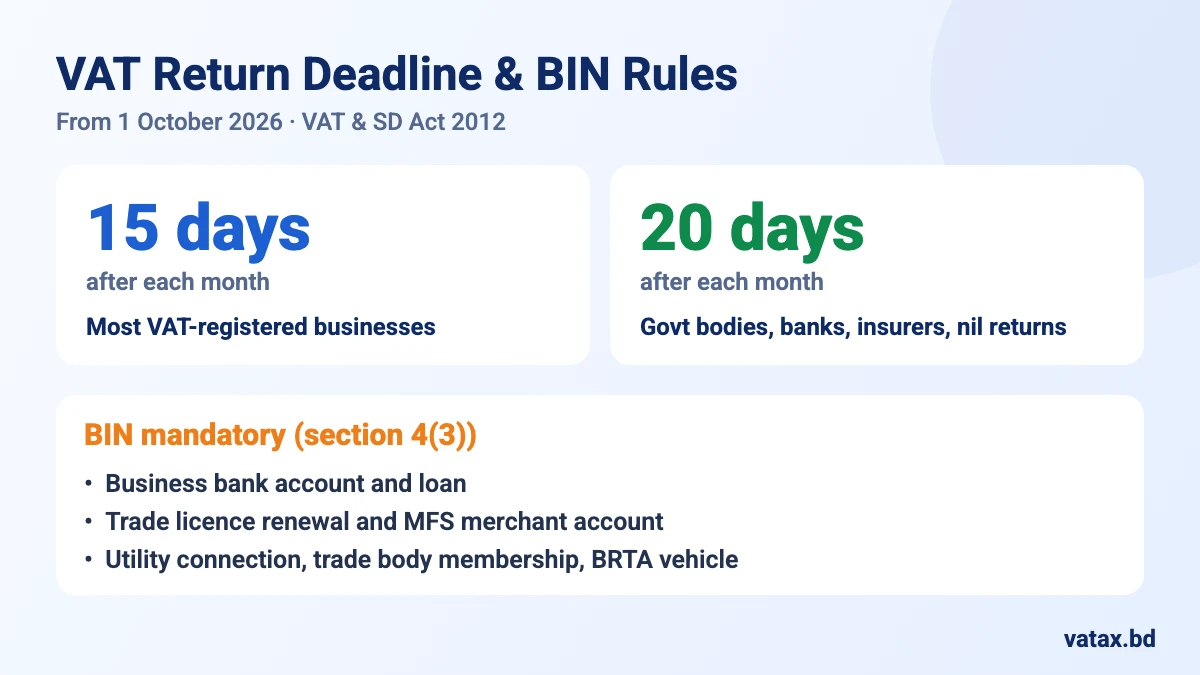
Yes. Under section 4(3) of the VAT & SD Act 2012 (added by the Finance Act 2026) and Bangladesh Bank's circular of 11 October 2026, a business needs a BIN or turnover-tax enlistment certificate to open or operate a current or STD account, take a loan, renew a trade licence and in four other cases. Read our full BIN mandatory guide.
When is the VAT return due?
From 1 October 2026, VAT returns are filed for every month (tax period). The deadline is 15 days after the month ends for most businesses, and 20 days for government bodies, banks and insurers and for nil returns. VAT returns are filed online only.
Do I file a VAT return in a month with no sales?
Yes. Every registered person files a return for each tax period, including a nil return when there were no transactions.
Which Mushak forms are used most?
- Mushak 6.1 – purchase register
- Mushak 6.2 – sales register
- Mushak 6.3 – tax invoice
- Mushak 6.6 – VAT deduction at source certificate
- Mushak 9.1 – VAT return
- Mushak 4.3 – input-output coefficient (price) declaration for manufacturers; see our Mushak 4.3 guide
Must I display my VAT registration certificate?
Yes. Display the registration certificate or turnover-tax enlistment certificate, or a certified copy, at your business premises where everyone can see it.
Import and export (IRC, ERC, CCI&E) FAQ
What services does the CCI&E provide?
The Office of the Chief Controller of Imports and Exports (CCI&E) issues and renews the Import Registration Certificate (IRC), Export Registration Certificate (ERC) and multinational ERC; changes company name, address, ownership or nominated bank; issues duplicate certificates; cancels registrations; approves import or export of restricted items; and issues no objection certificates (NOC).
What services are available under an Import Permit (IP)?
Import Permits cover special cases such as goods for exhibitions, release of goods seized by customs, free samples and gift items, capital machinery, re-import of vehicles under carnet de passages, firearms, imports on return basis (IP-cum-EP), imports against a proforma invoice and used clothing.
What is the IRC and ERC fee?
The IRC fee depends on your yearly import limit (Tk 5,000 to Tk 80,000 plus 15% VAT). The ERC fee is flat: Tk 10,000 plus VAT for a new ERC and Tk 7,000 plus VAT per year for renewal. Use our IRC fee calculator and ERC fee calculator.
What documents are needed for an ERC or IRC?
- Trade licence
- Membership certificate of the relevant trade organisation
- TIN certificate and BIN
- Tax return acknowledgement (PSR)
- NID of the proprietor, partners or directors
- Certificate of incorporation, Form XII and MOA/AOA (for a company)
- Passport-size photo
- Bank solvency certificate
Company registration and audit FAQ
What information is needed to register a private limited company?
For each shareholder and director: NID or passport, photo, phone, email, present and permanent address, father's and mother's names, and share percentage. For the company: proposed name, authorised and paid-up capital, and nature of business. See our company registration guide and RJSC fee calculator.
What documents does a company need for its yearly audit and tax return?
- Bank statements for 1 July to 30 June
- Cash sales book, purchase and sales ledgers
- Last year's audited accounts
- Salary details for 12 months
- Office and factory rent for 12 months
- VAT returns for 12 months
- All TDS and VDS challans and certificates
Foreign investment, visa and licence FAQ
What documents are needed for a PI (private investor) visa?
Scanned copies of all used passport pages, certificate of incorporation, MOA and AOA signed by the shareholders, and a board resolution naming the foreign investor with nationality and passport number, together with proof of investment as required by the authority.
What documents are needed for a work permit?
Depending on the case: the permission letter for a branch, liaison or representative office, or the MOA/AOA and certificate of incorporation of a local company; the appointment letter; the employee's passport and photo; and, for project staff, an authorisation letter from the project authority.
What is needed to register an industrial project with BIDA?
A project profile, directors' profiles, product list and production capacity, machinery list and an investment forecast in USD and BDT, plus supporting papers such as directors' NID or passport, certificate of incorporation, MOA/AOA and trade licence.
What documents are needed for a fire licence?
NID or passport, certificate of incorporation and MOA/AOA for a company, trade licence (if issued), building layout or plan, tenancy agreement with rent receipt for rented premises, and the fire safety plan and installation details.
বাংলায় সাধারণ প্রশ্নোত্তর (FAQ)
আয়কর রিটার্ন কবে দাখিল করব (২০২৬-২৭)?
অর্থ আইন ২০২৬ অনুযায়ী ১ জুলাই থেকে ৩০ জুন পর্যন্ত যেকোনো সময় দাখিল করা যায়। ১ জুলাই–৩০ সেপ্টেম্বর দাখিলে প্রদেয় করের ৫% বা ২৫,০০০ টাকা (যেটি কম) প্রণোদনা; ১ অক্টোবর–৩১ ডিসেম্বর নিরপেক্ষ; ১ জানুয়ারি–৩১ মার্চ ২% বা ৩,০০০ টাকা (যেটি বেশি) অতিরিক্ত কর; ১ এপ্রিল–৩০ জুন ৫% বা ৫,০০০ টাকা (যেটি বেশি)।
আয়ের খাত কয়টি?
আয়কর আইন ২০২৩-এ সাতটি খাত: চাকরি (বেতন), ভাড়া, কৃষি, ব্যবসা, মূলধনি লাভ, আর্থিক পরিসম্পদ থেকে আয় এবং অন্যান্য উৎস।
ই-টিআইএন কীভাবে পাব?
incometax.gov.bd ওয়েবসাইটে বিনামূল্যে অনলাইনে নিবন্ধন করে সঙ্গে সঙ্গে ১২ ডিজিটের টিআইএন সনদ ডাউনলোড করা যায়।
কে নিবাসী করদাতা?
আয়বর্ষে বাংলাদেশে ১৮৩ দিন বা তার বেশি থাকলে, অথবা আয়বর্ষে ৯০ দিন বা তার বেশি এবং আগের চার বছরে মোট ৩৬৫ দিন বা তার বেশি থাকলে তিনি নিবাসী।
সংশোধিত রিটার্ন কত দিনের মধ্যে দেওয়া যায়?
ধারা ১৮০(২) অনুযায়ী মূল রিটার্নের ১৮০ দিনের মধ্যে; তবে সংশোধিত রিটার্নে মূল কর দায় কমানো যায় না।
ভ্যাট রিটার্নের শেষ তারিখ কবে?
১ অক্টোবর ২০২৬ থেকে প্রতি মাসের রিটার্ন মাস শেষের ১৫ দিনের মধ্যে; সরকারি প্রতিষ্ঠান, ব্যাংক, বিমা ও শূন্য রিটার্নের ক্ষেত্রে ২০ দিন।
ব্যাংক হিসাবে কি BIN লাগবে?
হ্যাঁ। মূসক আইনের ধারা ৪(৩) ও বাংলাদেশ ব্যাংকের ১১ অক্টোবর ২০২৬-এর নির্দেশনা অনুযায়ী ব্যবসায়িক চলতি/STD হিসাব, ঋণ ও ট্রেড লাইসেন্স নবায়নসহ ৭টি ক্ষেত্রে BIN বা তালিকাভুক্তি সনদ লাগবে।
ERC ফি কত?
নতুন ERC ১০,০০০ টাকা + ১৫% ভ্যাট = ১১,৫০০ টাকা; নবায়ন প্রতি বছর ৭,০০০ টাকা + ভ্যাট।
Didn't find your answer?
Ask a tax lawyer. VATax Advisory & Co. handles income tax returns, VAT, IRC/ERC, company registration and foreign investment compliance across Bangladesh.
Sources: Income Tax Act 2023; Finance Act 2026; NBR Income Tax Guide and Circular 2026-27; VAT & SD Act 2012 and the VAT & SD (Amendment) Ordinance 2026; Bangladesh Bank BRPD circular letter 35 (2026); CCI&E fee schedule; National Board of Revenue. This FAQ is general information, not legal advice for a specific case.